Business Analyst to Product Manager: The Rung Nobody Puts on the Ladder
Three India career ladders list both Business Analyst and Product Manager. None puts them next to each other -the move guides sell as one promotion is really two, and the rung in between is the one that decides whether you arrive.
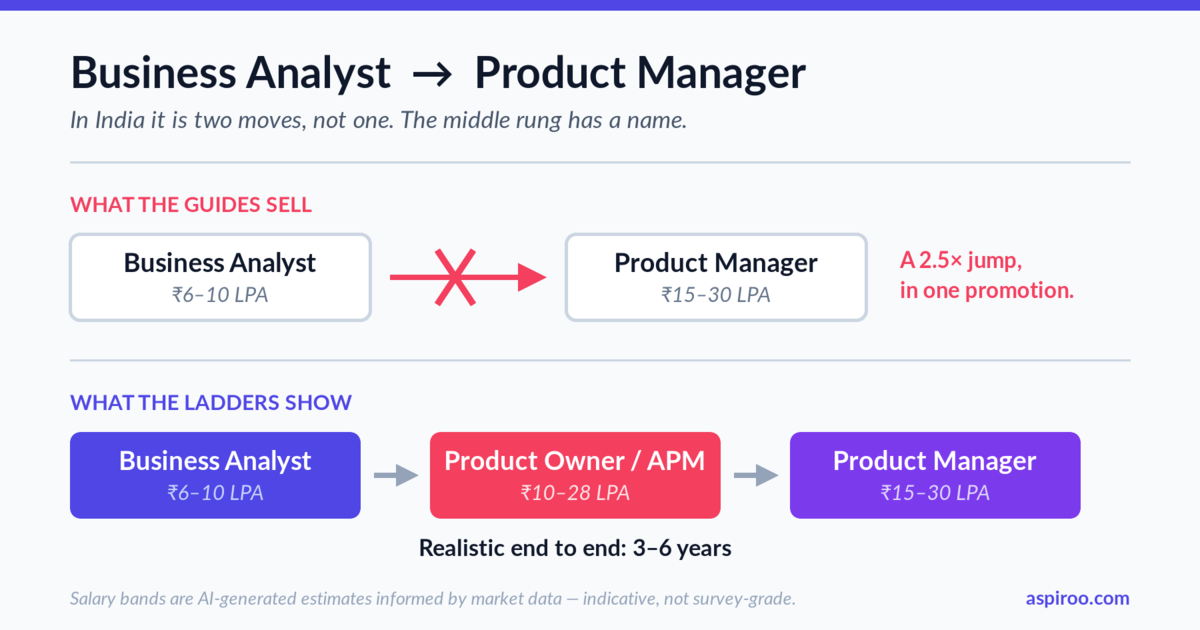
If you are a Business Analyst in India aiming at Product Manager, here is the short version: it is a real move, it is a well-worn one, and it is almost never a single promotion. Aspiroo's career-graph data holds three separate ladders that contain both roles — the Business Analyst path, the Product Owner path and the Product Manager path — and not one of them places Business Analyst directly next to Product Manager. There is always something in between. In India that something usually has the word Owner in the title.
Plan for two moves over three to six years, not one interview cycle. Everything below is the detail behind that sentence.
The pay maths gives the game away
A Business Analyst in India sits at roughly ₹6–10 LPA. A Product Manager sits at roughly ₹15–30 LPA. Both figures are AI-generated estimates informed by market data — indicative rather than survey-grade — but the shape is what matters, and the shape is a 2 to 2.5× multiple.
Indian organisations do not hand out 2.5× internal promotions. Appraisal cycles move people 10–30%. A role change moves people 40–60%. Nothing in a normal compensation structure moves someone from ₹8 LPA to ₹20 LPA in one step, and if a company were willing to, they would hire externally instead. So when a guide shows you a BA box and a PM box with an arrow between them, the arrow is doing work no real promotion committee will do for you.
A gap that large is not a promotion. It is a missing rung.
The rung, named
Look at what the three ladders actually contain and the missing piece resolves immediately.
The Business Analyst ladder's next steps after the core BA role are Senior Business Analyst (₹9–15 LPA), Product Owner (₹10–18 LPA), Project Manager (₹12–20 LPA) and Business Consultant (₹15–25 LPA). Product Manager is not on that list at all.
The Product Manager ladder runs the other way. It lists Business Analyst as an entry-level feeder role — ₹4–8 LPA, one to three years — and then places a whole mid-level tier before the PM title: Associate Product Manager (₹8–15 LPA), Product Analyst, Technical Project Manager.
The Product Owner ladder ties the two together explicitly. It starts from Business Analyst and Associate Product Manager, passes through Senior BA and Junior Product Manager, lands on Product Owner at ₹12–28 LPA, and lists Product Manager (₹15–40 LPA) as a subsequent step, with the move typically taking a further four to seven years to fully mature.
Three independent views of the market, all saying the same thing: Business Analyst → Product Owner or Associate PM → Product Manager. The middle rung is not a consolation prize. It is the load-bearing step.
What actually changes at each step
The useful question is not "what skills does a PM have." It is "which skills are genuinely new at this step" — because everything else, you already do.
BA → Product Owner. The new skills are product vision, backlog management, agile leadership, market research, user stories and prioritisation. Notice what is not on that list: requirements elicitation, stakeholder communication, SQL, process mapping. You keep all of those. This is why the step is achievable — it is roughly 60% of what you already do, plus the authority to decide sequence.
Product Owner → Product Manager. The new skills are product vision and strategy, market analysis, user research, go-to-market strategy, business acumen and P&L management, and cross-functional leadership.
That fifth one is the whole move. Every previous step in your career has measured you on delivery: were the requirements right, did the sprint close, did the release ship. The PM step is the first time you are measured on a number that has nothing to do with delivery — revenue, retention, activation, margin. You can deliver flawlessly and still be judged to have failed. That inversion, not any tool or certification, is the thing people find hard.
What the incumbent guides leave out
Search business analyst to product manager and you will get roadmaps that are genuinely useful on mindset and genuinely misleading on structure.
Techcanvass's 2026 roadmap (updated April 2026) publishes an India salary table with BA and PM side by side and hikes of "50–100%+" — accurate on the gap, silent on the fact that nobody clears it in one hop. Exponent's guide is thoughtful about the internal-versus-external decision, but its salary figures are entirely US dollars, and its main structural suggestion is joining a two-year Associate Product Manager programme at Google, Meta or Twitter — cohort programmes that a mid-career BA in Pune or Chennai realistically cannot apply to.
Both are, in a sense, describing the middle rung without naming it. An APM programme is the intermediate step. So is Product Owner. The Indian version simply does not come with a cohort, a mentor and a press release — it comes as a title change on an internal team.
The other omission is the direction of the move. In India, the intermediate rung is far more often Product Owner than Associate PM, because Indian delivery organisations — GCCs, services firms, enterprise product teams — are structured around Scrum, and Scrum has a Product Owner slot with a budget line attached. If you are optimising for the fastest legitimate route to product work, the PO role is the door that is actually open.
If you are two years in
Do not chase the PM title yet. At ₹4.5–7 LPA as a Junior BA, the constraint is that you have not yet owned a full requirements lifecycle end to end, and no one will hand you a backlog before you have. Spend the time getting to the core BA role — two to four years is the typical residency there — and use it deliberately: volunteer for the product-facing half of your projects, learn the prioritisation frameworks (RICE, MoSCoW) before anyone asks, and get comfortable saying no to a stakeholder with a reason attached.
The single highest-leverage habit at this stage is cheap: when a request arrives, write down the business outcome it is meant to produce before you write the requirement. Do it for a year and you will have the PM instinct before you have the PM title.
If you are seven or eight years in
Your risk is different, and it is real. A Senior BA at ₹9–15 LPA who waits for a PM opening is competing against candidates who already have product on their CV, and the longer you sit at Senior BA the more you look like a specialist in documentation rather than a generalist in outcomes.
The move to make is lateral and slightly uncomfortable: take a Product Owner role, possibly at flat or near-flat compensation, in a team whose product you understand well. The PO band (₹12–28 LPA) overlaps yours at the bottom, so the downside is bounded, and it converts your CV from analysis to ownership in one line. From there the PM step is a scope expansion rather than a career change — which is exactly how hiring managers read it.
Do not take the Project Manager fork if PM is the goal. It pays comparably (₹12–20 LPA), it is easier to get, and it moves you toward schedule and budget rather than toward the market. It is a fine career. It is not this one.
The honest conclusion
The BA-to-PM move is one of the most natural transitions in Indian tech, and most of what is written about it is true about mindset and wrong about time. You are not one certification away. You are one intermediate role away — the Product Owner or Associate PM rung that the ladders all contain and the roadmaps all skip.
Name it, aim at it, take it, and the PM title stops being a leap and becomes the next thing that happens. Skip it, and you spend three years applying for a job whose salary band your current employer was never going to approve.