Career Freedom Isn't About Quitting
Most people think career freedom means quitting. It doesn't. It means knowing where the doors are — and how many there actually are.
Ask someone what freedom would look like in their working life and you will usually get a version of the same answer: leaving. Quitting the job. Going independent. Building something of their own. Freedom, in the popular telling, is a door marked exit.
It is a seductive picture, and a mostly useless one. Escape is available to very few people, it usually requires savings most do not have, and those who manage it frequently discover they have swapped a demanding manager for demanding clients. Framing freedom as escape makes it something you either win or do not, once, rather than something you can build.
There is a better definition, and it is far more attainable: freedom is the number of moves available to you from where you currently stand.
Autonomy is not a luxury feature
Psychologists have a precise name for this. Self-determination theory, developed by Edward Deci and Richard Ryan, holds that people have three basic psychological needs — autonomy, competence and relatedness. Autonomy in this sense is not doing whatever you like; it is acting from your own volition rather than from external pressure.
Decades of workplace research bear this out. Meta-analyses consistently find that satisfying the need for autonomy predicts higher job satisfaction, stronger engagement and lower burnout, while environments that frustrate it predict the reverse.
That research examines autonomy inside a role — how much discretion you have over your methods, your schedule, your decisions. The extension I want to make is one step beyond it, and worth naming plainly rather than smuggling in: autonomy over your career as a whole works the same way. A person who knows they have four realistic moves available holds a different posture at work than a person who believes they have none. Not because they use the moves. Because they know the moves are there.
The colleague who knows exactly what else they could do is the one who negotiates calmly, refuses the unreasonable project, and stays anyway. Options change your behaviour long before you exercise any of them.
India's seven-door problem
Here is the uncomfortable part. This kind of freedom is distributed very unevenly, and in India the distribution is worse than most people assume.
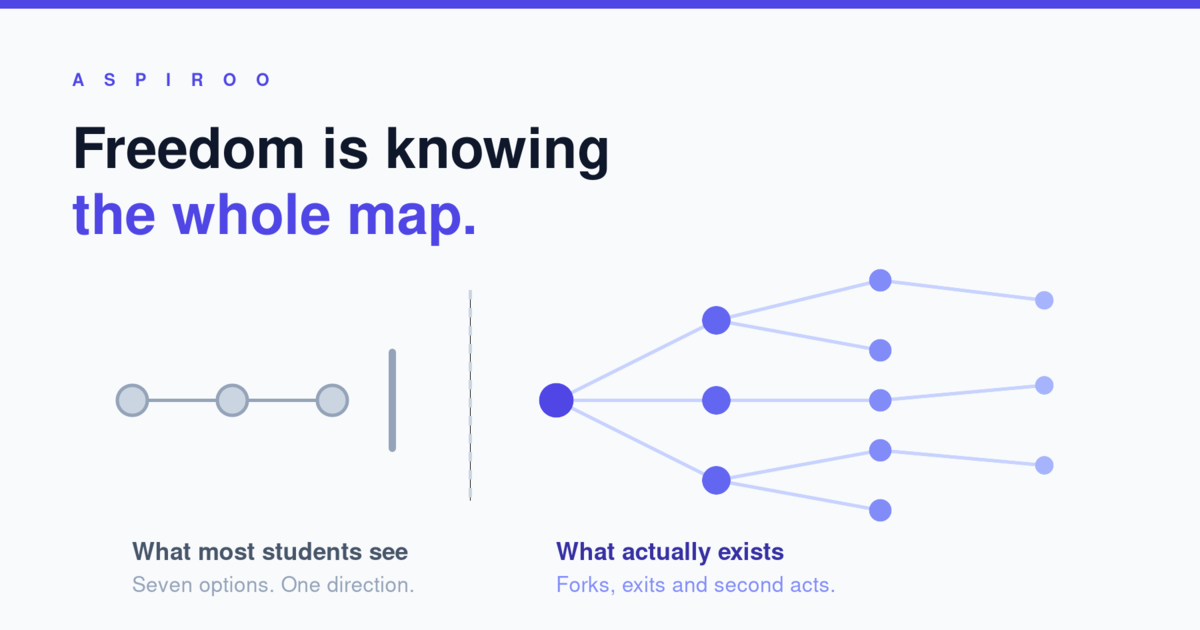
In a survey of more than 10,000 students aged 14 to 21, the career-counselling platform Mindler found that 93% were aware of only seven career options — out of more than 250 that actually exist across roughly 40 domains. Seven doors, in a building with two hundred and fifty.
Read that carefully, because the obvious interpretation is the wrong one. This is not a story about ambition, or aptitude, or effort. Those students are not failing to reach the other doors. They cannot see them. Engineering, medicine, law, commerce and a handful of others are visible because they are socially legible — a parent can name them, a relative can vouch for them, a neighbour recognises them as success. Everything else is dark.
Then a decision gets made at seventeen, from a menu of seven, and it hardens. Not because it is irreversible, but because nobody involved can see what reversing it would even look like. The corridor feels like a corridor because the map ends at the walls.
What actually buys you freedom
If freedom is optionality, then it is built from three specific pieces of knowledge — and none of them is inspiration.
Which moves are adjacent to you. Not every career, which is useless. The handful of roles genuinely reachable from where you are now. A Business Analyst sits one deliberate step from product, from data, and from consulting. Most Business Analysts have never been told this.
What each move costs in time. "You could move into data science" is not advice; it is a shrug. Knowing that the path typically runs Junior Data Analyst → Business Intelligence Analyst → Data Analyst → Data Scientist, with a couple of years at most stages, turns a vague possibility into something you can actually decide about. You might still say no. But you will be saying no to a real thing.
Which of your skills transfer. Most people badly underestimate this, and so start from zero when they did not need to. The SQL and stakeholder work a Business Analyst already does carries almost entirely into an analytics role. What is genuinely new is a much shorter list than it appears from outside.
Notice what these three have in common. They are not personality traits. They are facts — and facts can be looked up, which means this particular form of freedom is one of the few that can be handed to someone.
A blueprint, by stage
If you are still choosing
Do not start by asking what you want to be. You have seen seven options; the question is unanswerable with that little information. Start by enlarging the menu. Read about roles you cannot yet name, including unglamorous ones. Your aim at this stage is not a decision — it is a bigger map to decide from later.
If you are early in your career
You are in the period where moves are cheapest and most people make none, because the first job feels like a verdict. It is not. Spend an hour finding out what your current role leads to — not the promotion above you, but the sideways doors. Then pick one skill on the path you find most interesting and start on it while you are still being paid to learn other things.
If you are mid-career
Your risk is the opposite: the ladder is now so visible that it looks like the only structure in the building. Seniority is where a career stops being a queue and becomes a fork — deep specialisation, people leadership, architecture, or a lateral move into a domain where your experience is scarce and therefore valuable. The Product Manager who moves into a regulated industry has not started over. They have made their existing knowledge rarer.
Where Aspiroo fits
This is the problem Aspiroo was built for, and it is worth being precise about what it does rather than overselling it.
Most career resources answer what does this job pay? — a question already well served by salary aggregators. Aspiroo answers a different one: what is the whole shape of this path? Each role is mapped end to end — the roles that lead into it, the stages between, how long each stage typically takes, the skills that become relevant at each step, and critically, where the path forks once you arrive.
You can browse every mapped role, or explore a specific role and market interactively. Salary figures are shown as ranges by stage and are AI-generated estimates informed by market data — indicative rather than survey-grade, and labelled as such, because a confident wrong number is worse than an honest range.
What Aspiroo cannot do is make the decision. It has no opinion on whether you should move. It only insists that you should be able to see the doors before you choose one.
The quiet version of freedom
The dramatic version of career freedom — the resignation, the leap — makes better stories. The quiet version makes better lives.
The quiet version is a person who knows there are four things they could do next, roughly what each would cost, and which parts of their experience would come with them. That person negotiates differently. They take better risks, and fewer bad ones. They are far harder to trap.
They are not free because they left. They are free because they can see the map, and the map turned out to be much larger than seven doors.