Data Analyst to Data Scientist: The Real Timeline, and the Pay Dip Nobody Mentions
Most guides sell a six-month switch. India's actual career ladders tell a different story — a two-to-three-year move, in which your first data-science title pays less than the analyst job you already have.
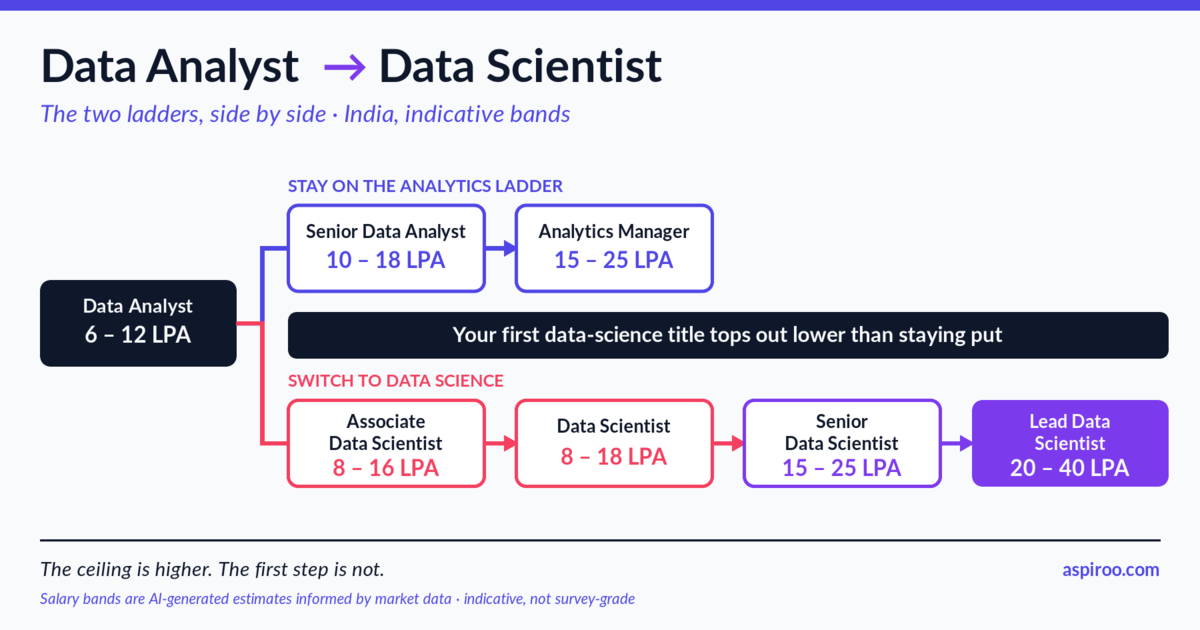
If you are a Data Analyst in India wondering how long it takes to become a Data Scientist, the honest answer is two to three years from where you stand now — not the six months you will see advertised. And there is a detail the course adverts leave out entirely: your first data science title will probably pay you less than simply staying on the analyst track for the same period.
That is not a reason to abandon the move. It is a reason to plan it properly. Aspiroo's Data Analyst career path for India puts an Associate Data Scientist at 8–16 LPA, while a Senior Data Analyst — the role you would have grown into anyway — sits at 10–18 LPA. The top of the band is lower on the data science side. The money arrives two stages later, and it arrives big. But it does not arrive on day one.
All salary figures here are AI-generated estimates informed by market data. They are indicative bands for planning, not survey-grade numbers.
You are already on the ladder
Start with the thing that reframes the whole question.
Open the Data Scientist career path and look at what sits in the entry and mid-level stages. Junior Data Analyst. Business Intelligence Analyst. Data Analyst. The role you already hold is not a different ladder you need to jump across. It is a rung on the data science ladder itself.
This matters more than it sounds. Most of the guidance treats the move as a career change — a switch of tracks that requires you to re-qualify, retrain and re-enter at the bottom. It isn't. It is a promotion within a progression you are already standing on. The framing changes what you do next: you stop looking for a way out of analytics and start looking for the next stage of it.
The typical route runs Junior Data Analyst (1–2 years) → Data Analyst (2–3 years) → Data Scientist, at roughly three to five years of total experience. If you are already a Data Analyst with two years behind you, you are not starting the journey. You are somewhere in the middle of it.
What actually has to change
Aspiroo's "Moving Between Stages" data is specific about what is genuinely new at this step, as opposed to what you already do every day. Moving from Data Analyst to Associate Data Scientist, the new skills are:
- Python for modelling — Scikit-learn, Pandas, NumPy
- R
- Machine learning, supervised and unsupervised
- Statistical modelling
- Data engineering basics
- Storytelling at a level that survives contact with an executive
Everything else — SQL, Excel, dashboarding, A/B testing, data cleaning — you already use. That is the useful half of the list, and it is the half the seven-step guides never show you. You are not learning a discipline from scratch. You are adding roughly six competencies to a foundation you spent years building.
Notice what is not on the list: deep learning, Spark, MLOps, causal inference. Those belong to the Senior Data Scientist stage, two rungs up. Learning them now is not preparation, it is procrastination.
The pay curve, told honestly
Here is the sequence, with Aspiroo's India bands:
| StageBandTypical time | ||
| Data Analyst | 6–12 LPA | 3–5 years total experience |
| Associate Data Scientist | 8–16 LPA | 5–8 years |
| Data Scientist | 8–18 LPA | 3–5 years |
| Senior Data Scientist | 15–25 LPA | 3–5 years |
| Lead / Data Science Manager | 20–40 LPA | 2–4 years |
Compare that with staying put: Senior Data Analyst at 10–18 LPA, and Analytics Manager at 15–25 LPA — reachable in six to ten years without ever writing a model.
So the analyst track is not the poor relation. In the first three years after the switch, it is arguably ahead. What the data science track buys you is the ceiling. Principal Data Scientist and Data Architect reach 30–60 LPA and beyond; there is no equivalent rung on the pure analytics ladder. You are trading near-term earnings for a much higher terminal band.
The commonly repeated claim of a "40–70% salary jump" on switching is not what the stage data shows. A jump of that size does happen — it happens between Associate Data Scientist and Senior Data Scientist, three to five years after you make the move.
The route the guides never mention
There is a second doorway into modelling work that almost nobody writes about, and it is visible on the same ladder: Associate Machine Learning Engineer, 6–12 LPA, one to two years.
It sits parallel to Data Analyst as a mid-level stage on the data science path, and it asks for a different mix — Python, ML algorithms, Scikit-learn, basic TensorFlow or PyTorch, model evaluation, Git. It weights engineering practice over statistical depth. For an analyst who already codes and finds pipelines more natural than hypothesis tests, it is often an easier entry into model work than a Data Scientist opening, because it competes against a smaller and less credentialed pool. From there, Machine Learning Engineer and Data Scientist are both live options.
Two doors, not one. Most guides show you the crowded one.
If you are a student
The most useful thing in all of this for someone still studying: do not try to enter directly as a Data Scientist. The ladder shows almost nobody does. The entry stages are Junior Data Analyst (3–6 LPA) and Junior BI Analyst (4–8 LPA), and they exist because model-building on real business data requires context you can only get by working with that data first.
Take the analyst job. It is not a compromise or a detour — it is stage one of the path you actually want, and it pays you while you learn the domain knowledge that later separates a competent modeller from a useful one.
One correction worth making: several popular guides state that a data science role "often requires a master's or PhD". Great Learning's own transition guide says exactly this in its comparison table, then contradicts it in its FAQ a thousand words later. India's ladder data does not support the requirement. Progression here runs on stages and demonstrated scope, not degrees.
If you are already three or four years in
Your risk is different. It is not getting in; it is arriving as a junior.
The move only works if you carry your existing seniority across. That means resisting a role that resets you to entry-level modelling work, and instead looking for the version of the job where your analyst experience is the point — experiment design, causal questions, a domain you already know cold. A Data Scientist who understands lending, or logistics, or retail pricing is worth considerably more than one who understands only Scikit-learn, and you are already the former.
The practical sequence: build the modelling skills inside your current role, on your current company's data, before you change employers. An internal move protects your band; an external one exposes it. Then switch companies from the new title, not into it.
The one-line version
You are already on the data science ladder. The gap is roughly six skills, not a new career. Budget two to three years, expect the pay curve to flatten before it climbs, and take the internal route if one exists.
Then look at the whole ladder rather than the next rung — the Data Analyst and Data Scientist paths both fork further up, and the fork you choose at Senior matters far more than the title you take next year.