Data Engineer to Data Architect: The Fork at Senior Level Nobody Maps, and What Each Branch Pays
Becoming a Data Architect is not a promotion you earn by getting better at Spark. It is a change in what you are accountable for. If you are early, build the engineering base and take scope early. If you are senior, choose your branch on purpose, because the three pay bands overlap heavily, while the way you will spend your weekdays differs completely.
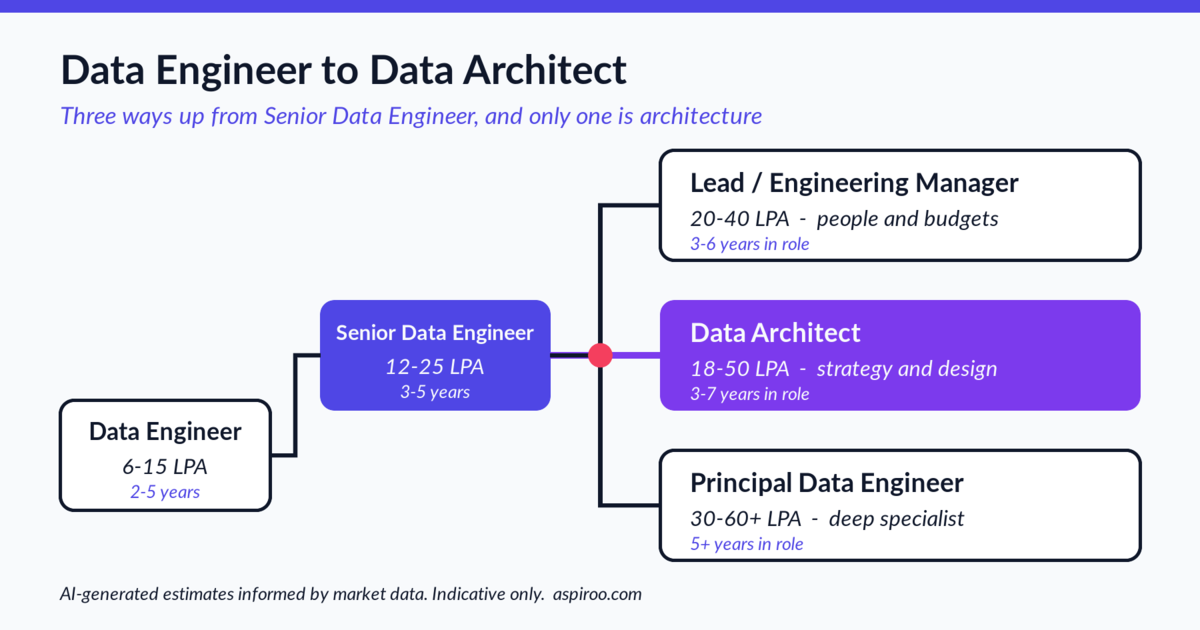
If you are a Data Engineer in India wondering what it takes to become a Data Architect, the honest answer is roughly five to ten more years, and a change in what you are paid for rather than a change in tools. Aspiroo's career data puts the Data Architect band at 18–50 LPA, against 6–15 LPA for a Data Engineer, but the route does not run in a straight line: almost nobody jumps straight across. The usual route runs through Senior Data Engineer, and at that point the ladder forks three ways. Architecture is only one of them.
That fork is the part most guides skip, and it is the part that decides whether the move is right for you.
All salary figures in this post are AI-generated estimates informed by market data. They are indicative bands for planning, not survey-grade numbers.
The ladder, with the years attached
Aspiroo's Data Engineer career path lays the route out stage by stage. The entry points are a Junior Data Analyst (1–2 years) or a Junior Software Developer (1–2 years). From there you pass through a mid-level stage, either BI Developer (2–3 years) or Software Engineer (Data Focus) at 2–4 years, before reaching Data Engineer itself at 6–15 LPA, where people typically spend 2–5 years.
After that comes Senior Data Engineer at 12–25 LPA, typically 3–5 years. Add the stage durations along the software route (1–2, 2–4, 2–5 and 3–5 years) and you reach the doorstep of architecture roughly eight to sixteen years after your first job. That is simple arithmetic on ranges, so treat it as a rough envelope, not a promise. It does explain why Data Architect is a mid-career destination, not an early one.
The fork at Senior Data Engineer
Here is where the Aspiroo data gets interesting. From the senior stage there are three distinct directions, each with a different day-to-day job:
- Lead Data Engineer / Data Engineering Manager, at 20–40 LPA. The new skills are team leadership, Agile and Scrum delivery, budgeting and vendor management. You stop building pipelines and start being accountable for the people who do.
- Data Architect, at 18–50 LPA depending on which Aspiroo page you read (more on that below). The new skills are enterprise data strategy, solution architecture, data governance, big data technologies, cloud architecture and NoSQL design. You stop building the pipeline and start deciding which pipelines should exist.
- Principal Data Engineer, at 30–60+ LPA. You stay hands-on, go deeper across several data domains, and become the person other engineers consult. It is a specialist's ceiling, not a manager's.
Aspiroo's own wording is that the path "forks here: some move deeper into technical specialisation, others into people management, and the two lead to very different day-to-day work." Architecture sits awkwardly between the two. It is technical, but the output is documents, standards and decisions rather than code, and a good deal of the job is persuading other teams to follow them.
What actually changes at the architect step
The transition data says the move from Data Engineer to Data Architect "is a change in scope, not just a title". The new skills are enterprise data strategy, solution architecture, data governance, big data technologies, cloud architecture and NoSQL databases. People then typically spend four to seven years in the role.
Read that list again. Only some of it is technology. Governance, strategy and solution design are about judgement under constraint: which of three reasonable designs to fund, how to keep a regulated dataset auditable, when a warehouse should become a lakehouse and when it should not. Aspiroo's Data Architect page makes the same point in its FAQ, noting that the skills that get you promoted into a role are not the ones that advance you beyond it, and that later stages weight judgement and business impact above tools.
The Data Architect career path adds a useful second route in. There, the listed feeder into the role is the Data Modeler (8–18 LPA), who designs conceptual, logical and physical models. If you enjoy schema design more than pipeline plumbing, that is a legitimate door, and it can be faster than waiting out three more years as a senior engineer.
Two pages, two salary bands
A note on honesty. The two Aspiroo pages do not quite agree. The Data Engineer page places the architect at 25–50 LPA; the Data Architect page places the same role at 18–40+ LPA. Both are AI-generated estimates, and the difference probably reflects how each page models the preceding stages. The sensible reading is that an architect in India plausibly lands between the high teens and the high forties, with company size, sector and cloud depth moving you around inside that range. Do not plan around the top figure.
One more oddity worth knowing: on the Data Engineer ladder, Software Engineer (Data Focus) is 7–13 LPA while Data Engineer is 6–15 LPA. The bands overlap heavily, so the move into the title itself buys you little immediate pay. The money arrives at Senior and beyond.
What the usual guides leave out
The top results for this query tend to be role comparisons rather than career paths. One comparison I read (Proxify, dated January 2022) gives no years per stage, no salary bands and no transition steps. That is the gap. Knowing how the two roles differ in the abstract does not help you decide whether to spend the next three years chasing the title or going Principal instead.
Advice by audience
If you are a student or fresher. Do not aim at "Data Architect" as a first target. Aim at being a good Data Engineer, which means SQL, Python, a cloud platform, and one orchestration tool such as Airflow. Start from either analytics or software, since both are valid entries on the ladder. Architecture is a destination you can see from year eight, not year one.
If you are a Data Engineer with two to five years behind you. Your job now is to take on scope before you are given the title. Own a data model end to end. Write the design document for the next pipeline rather than just the code. Learn governance basics, because that is the new skill almost nobody practises early. Aspiroo's data says it directly: moving faster generally means taking on scope earlier, not skipping stages.
If you are a Senior Data Engineer. This is the decision point. Ask which of the three days you would rather live: managing people, designing systems for others to build, or being the deepest hands-on expert in the room. If the answer is not obvious, shadow an architect for a week before you commit.
The concrete conclusion
Becoming a Data Architect is not a promotion you earn by getting better at Spark. It is a change in what you are accountable for. If you are early, build the engineering base and take scope early. If you are senior, choose your branch on purpose, because the three pay bands overlap heavily, while the way you will spend your weekdays differs completely.
You can explore your own route on Aspiroo, and some role searches may ask you to sign in first. Start with the Data Engineer path, then compare it with the Data Architect path.