IC or Manager: The Fork Around Year Seven, and Why It Isn't the Pay Decision You Think It Is
If you are a software engineer deciding between staying an individual contributor (IC) and becoming a manager, the useful question is not "which pays more?" On Aspiroo's career data, the two tracks overlap heavily on pay. The better question is "which problems do I want to spend my days on?", because the work diverges sharply even where the salary does not. And the choice is more reversible than most guides admit, provided you test it before committing.
If you are a software engineer deciding between staying an individual contributor (IC) and becoming a manager, the useful question is not "which pays more?" On Aspiroo's career data, the two tracks overlap heavily on pay. The better question is "which problems do I want to spend my days on?", because the work diverges sharply even where the salary does not. And the choice is more reversible than most guides admit, provided you test it before committing.
The rest of this post explains where the fork sits, what the ladder data says about both sides, and what the top-ranking articles leave out.
Where the fork actually sits
Add up the typical durations on Aspiroo's Software Engineer career path and the fork lands later than people expect. Junior Software Engineer runs about 1–2 years, Software Developer 2–3, Software Engineer 2–5. That puts the first real choice, Senior Software Engineer to either Tech Lead or Staff, somewhere between roughly year five and year eleven. "Year seven" is the middle of that range, not a deadline.
It is a fork in the ladder, not the end of it. The Software Engineer page shows both routes leaving the same Senior stage:
- Management-leaning: Tech Lead (₹20–35 LPA, 2–4 years), then Engineering Manager (₹28–50 LPA, 3–5 years).
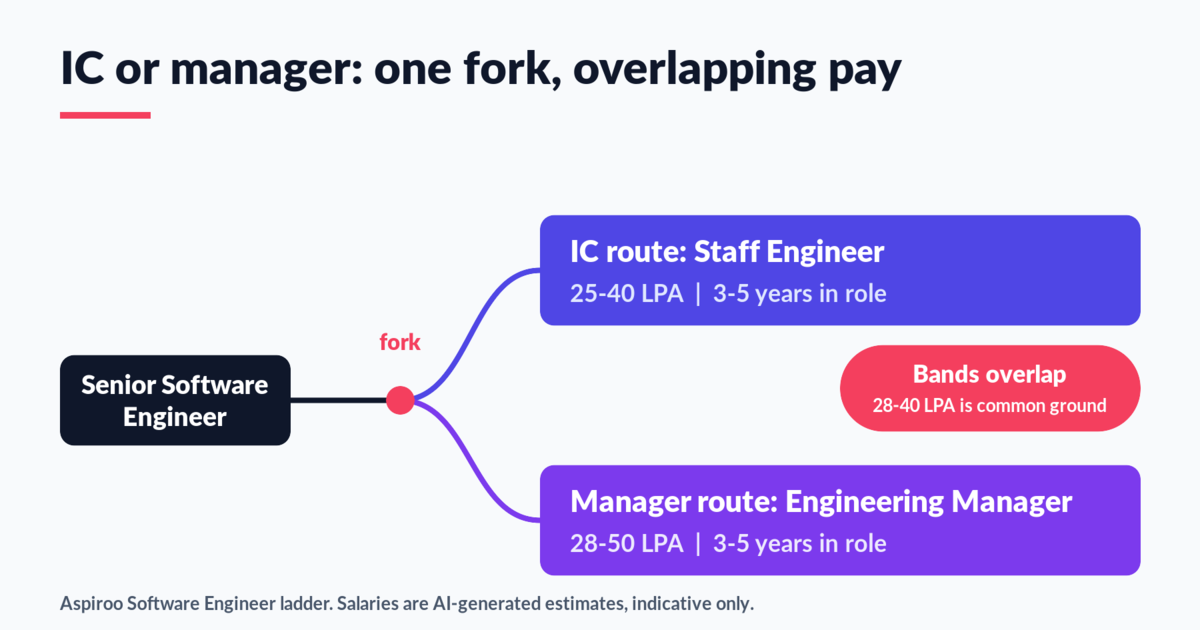
- IC-leaning: Staff Software Engineer (₹25–40 LPA, 3–5 years).
All salary figures in this post are AI-generated estimates informed by market data. They are indicative bands for planning, not survey-grade numbers.
What the pay data says (and where our own pages disagree)
On the Software Engineer page, Staff (₹25–40 LPA) and Engineering Manager (₹28–50 LPA) overlap across most of their range. The manager band tops out higher, but the floors are close, and the Staff band is not a consolation prize.
Aspiroo's CTO career path draws the IC side higher: it lists Principal / Staff Engineer at ₹45–75 LPA, above its Engineering Manager band of ₹28–50 LPA, and describes the Principal role as "often acting as an individual contributor with broad impact". These two pages do not agree on the exact numbers, which is itself useful information: titles and bands vary by company, and Staff at one firm can be Senior at another. Treat the overlap, not any single figure, as the finding. Whichever page you read, neither track is a pay ceiling by the Staff or Principal stage.
Where the ladders differ is what comes next. The CTO page shows Principal / Staff Engineer leading to CTO, 5+ years in role, with pay moving from ₹45–75 LPA to ₹70 LPA–2.5 Cr (highly variable). So the IC path does not close the door on leadership, and the management path does not guarantee a bigger paycheque.
What the top results leave out
Search this question and the leading articles are sensible but thin in the same places. The Educative guide (Erin Schaffer, March 2026) calls management "a career track change, not a promotion" and suggests testing it by running 1:1s or leading a cross-team project, but gives no salary figures and no India context. Zühlke's piece on IC versus manager roles, which has no named author, is built around employees who moved between tracks, and has no statistics. Built In's article by Mark Kinsella (January 2022) argues for a hybrid "IC manager" role and says the learning curve for management can take 6 to 12 months, which is his own observation, not sourced data.
Three gaps recur: none gives pay by level, none gives typical time in each role, and none addresses Indian employers. This post exists to fill those gaps with ladder data, while being honest that Aspiroo's bands are estimates.
If you are a student or early-career
You do not need to choose yet, and no ladder asks you to. The Software Engineer path puts the fork after at least five years of typical time in role. What you can do now is choose where you start. Prefer teams where engineers and managers both visibly progress, so you can watch both tracks up close. Build the fundamentals the ladder lists for Software Developer and Software Engineer (a language, data structures, SQL, then system design basics), because both tracks require them. A weak technical base makes Tech Lead rough and Staff impossible.
If you are mid-career
Treat the decision as an experiment, not a verdict. The practical tests from the Educative guide are good: run a few 1:1s, mentor juniors, or lead a project that crosses teams. Notice what energises you. Aspiroo's Tech Lead stage lists technical leadership, project planning, mentoring, architectural review and stakeholder communication as the new skills, and the Engineering Manager stage adds people management, performance reviews, recruitment and budgeting. If the second list sounds like a chore, that is data.
On reversibility: Zühlke's employee stories include people who moved from a managerial track back to IC work and kept progressing, and Built In treats moving back as an acceptable choice. These are accounts from individuals at specific employers, not evidence about the whole market, so do not rely on a smooth return. But they do suggest the move is not a trap door.
A simple decision rule
Ask three questions and answer them honestly. Do you get more satisfaction from a hard problem solved, or from a colleague who has grown? Would you rather be accountable for a system or for a team's results? And are you choosing management mainly because you think it is the only route to higher pay? The ladder data says it is not.
If you land on management, take a Tech Lead role first; Aspiroo's data shows it as the stepping stone, and it lets you find out cheaply. If you land on IC, aim at the Staff stage and the cross-team influence it carries, and see where the full Software Engineer ladder goes from there.
Aspiroo's career pages are free to browse, though some role searches ask you to sign in.