The Death of the Ticket-Taker: Redefining the Future of the Data Analyst
The traditional data analyst role is undergoing a massive paradigm shift as generative AI and advanced self-service tools automate routine tasks like SQL querying, report generation, and dashboard tweaking. The era of the centralized analytics team acting as a bottlenecked "ticket-taker" is giving way to a decentralized model where non-technical business units pull their own insights using natural language. To survive this wave of automation, data professionals across all career stages must shift their focus from technical syntax to building an un-automatable "career moat" anchored in deep business empathy, complex domain expertise, and strategic problem-solving. Ultimately, future success in the field depends on transitioning from a passive data fetcher into a high-leverage operational partner or data architect who drives actual business outcomes.
Two decades ago, data analysis was a largely fragmented, localised endeavour. A "Data Analyst" in the early 2000s spent their days wrestling with sprawling Excel spreadsheets, writing basic SQL queries, and building static desktop reports. As corporations realised the immense value hidden in their digital footprint, the discipline underwent a massive evolution.
The rise of mature Business Intelligence (BI) platforms like Tableau, Power BI, and cloud data warehouses transformed data analysis from a back-office IT chore into a highly specialised corporate discipline. Analysts became the translators of organisation-wide data, turning raw infrastructure into readable dashboards. However, the operational models built around this specialisation are hitting their expiration date. We are entering a new era where the traditional role of the intermediary data analyst is rapidly disappearing, forced to adapt to a highly automated landscape.
The Centralised Analytics Team Era and Its Bottlenecks
To manage the explosion of big data in the 2010s, enterprises overwhelmingly turned to a unified operational structure: the centralised analytics team. By grouping all data talent into a single core department, companies aimed to solve two massive problems: data governance (ensuring a single version of financial truth) and specialised skill grouping.
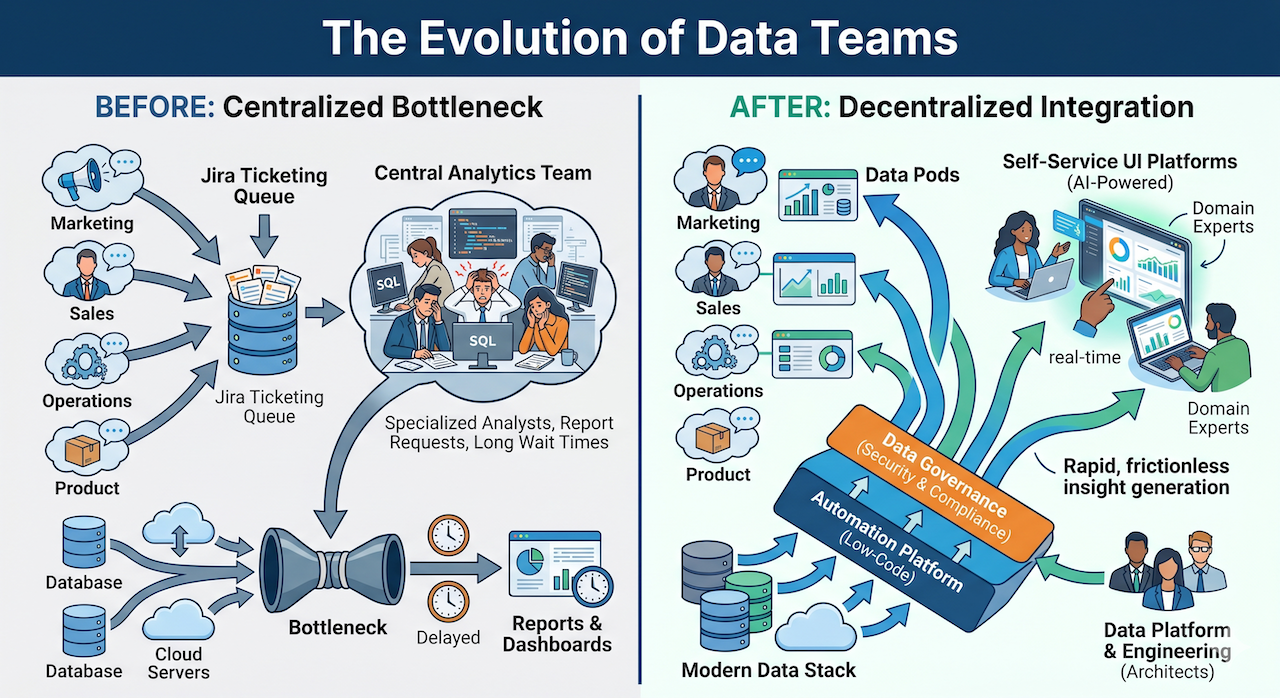
While this model successfully standardised metrics and guaranteed quality control, it inevitably introduced significant operational friction. The centralised team became an organisational bottleneck. Business units—such as marketing, sales, or product—had to submit requests through ticketing systems to get simple questions answered.
The result was a pervasive "ticket-taker" culture. Data analysts found themselves buried under an endless queue of repetitive tasks: building the same slightly altered revenue report, pulling ad-hoc lists, or fixing broken dashboard filters. This delayed business decision-making by days or even weeks.
The Rise of Self-Service and AI Automation
The centralised bottleneck has catalysed a major technological shift. Non-technical business units are no longer willing to wait in line for data. Instead, they are starting to analyse data themselves through a new wave of intuitive, AI-driven self-service tools.
Modern data platforms leverage large language models (LLMs) to democratize data access. Instead of waiting for an analyst to write a complex SQL query with multiple table joins, a marketing manager can now type a natural language question directly into a chat interface: "Show me our top-performing user acquisition channels in Q1, segmented by region." Within seconds, the system generates the query, pulls the data, and visualises the trend.
This wave of automation drastically reduces the need for traditional data teams to handle routine queries. Simple reporting, basic data cleaning, and ad-hoc visualisation are becoming commoditised features embedded inside native business applications. The traditional role of the intermediary analyst who simply fetches data is being automated out of existence.
A Strategic Blueprint for Data Professionals
As routine technical tasks are handed over to AI, the human value proposition must change. To remain competitive, individuals must shift from providing technical answers to delivering strategic outcomes.
For Students: Look Beyond the Syntax
If you are preparing to enter the workforce, relying solely on mastery of SQL, Python, or a specific BI tool is no longer a viable strategy. AI tools handle syntax flawlessly.
- The Blueprint: Shift your focus toward data architecture, data governance principles, and business strategy. Take courses in economics, operations, or product management.
- The Goal: Learn how a business actually operates and makes money. Practice translating vague business dilemmas into concrete analytical frameworks.
For Early-Career Professionals: Graduate from "Ticket-Taker" to Partner
If your daily routine consists of answering data Jira tickets and tweaking existing dashboards, your role is highly vulnerable to automation. You must proactively change how your peers perceive your value.
- The Blueprint: Stop waiting for tickets. Embed yourself deeply into the operational meetings of the business units you support. If you cover marketing data, learn marketing attribution models inside and out.
- The Goal: Transition from a passive order-taker to an active operational partner. Use data to suggest growth opportunities or identify cost leaks before stakeholders even think to ask for a report.
For Mid-Career Professionals: Pivot to High-Leverage Domains
For established professionals, the path forward requires moving away from generalist analysis and leaning heavily into advanced, specialised engineering or leadership tracks.
- The Blueprint: Identify high-leverage pivots. This could mean transitioning into data engineering (building the robust pipelines that power self-service tools), analytics engineering (modelling complex data schemas), or deep domain leadership (managing data product strategy for an entire business segment).
- The Goal: Position yourself as the architect of the data ecosystem rather than a consumer of it.
Conclusion: Building Your Career Moat
The future of data analysis belongs to those who understand that data is a means to an end, not the end itself. The technical barrier to entry for manipulating data is falling to zero, which means your technical skills alone can no longer serve as a defensible barrier for your career.
To thrive, you must build a career moat out of qualities that AI cannot replicate:
- Deep Business Empathy: The ability to understand human frustrations, organisational politics, and the nuanced risk tolerances of executives.
- Complex Domain Expertise: Possessing historical context and operational knowledge unique to your specific industry or business model.
- Strategic Problem-Solving: The creative capability to identify anomalous patterns in data and ask the critical, unexpected questions that algorithms miss.
AI will inevitably take over the mechanics of data retrieval and dashboard creation. Rather than viewing this as a threat, forward-thinking professionals will view it as a liberation. By offloading routine technical tasks to automated systems, the data professional of tomorrow is finally free to focus on what matters most: driving strategic impact.