The Rise of the Data Orchestrator: Why the "Full Stack Data Professional" is the Future of Work
For years, we have prioritised hyper-specialised silos—Data Engineers for plumbing, Data Scientists for math, and Analysts for stories. But in the 2026 economy, the "coordination tax" of these silos is killing organisational efficiency. The future belongs to the Full Stack Data Professional. By leveraging "Vibe Coding" and Low-Code/No-Code platforms, these generalists are bridging the gap from raw data to business strategy in days, not weeks. They aren’t just "tool operators"—they are strategic orchestrators who use AI to handle the routine, allowing them to focus on the high-value logic your business needs. In a market where 82% of businesses report a shortage in developer talent, empowering your team to own the entire "stack" isn't just a trend—it’s a competitive necessity.
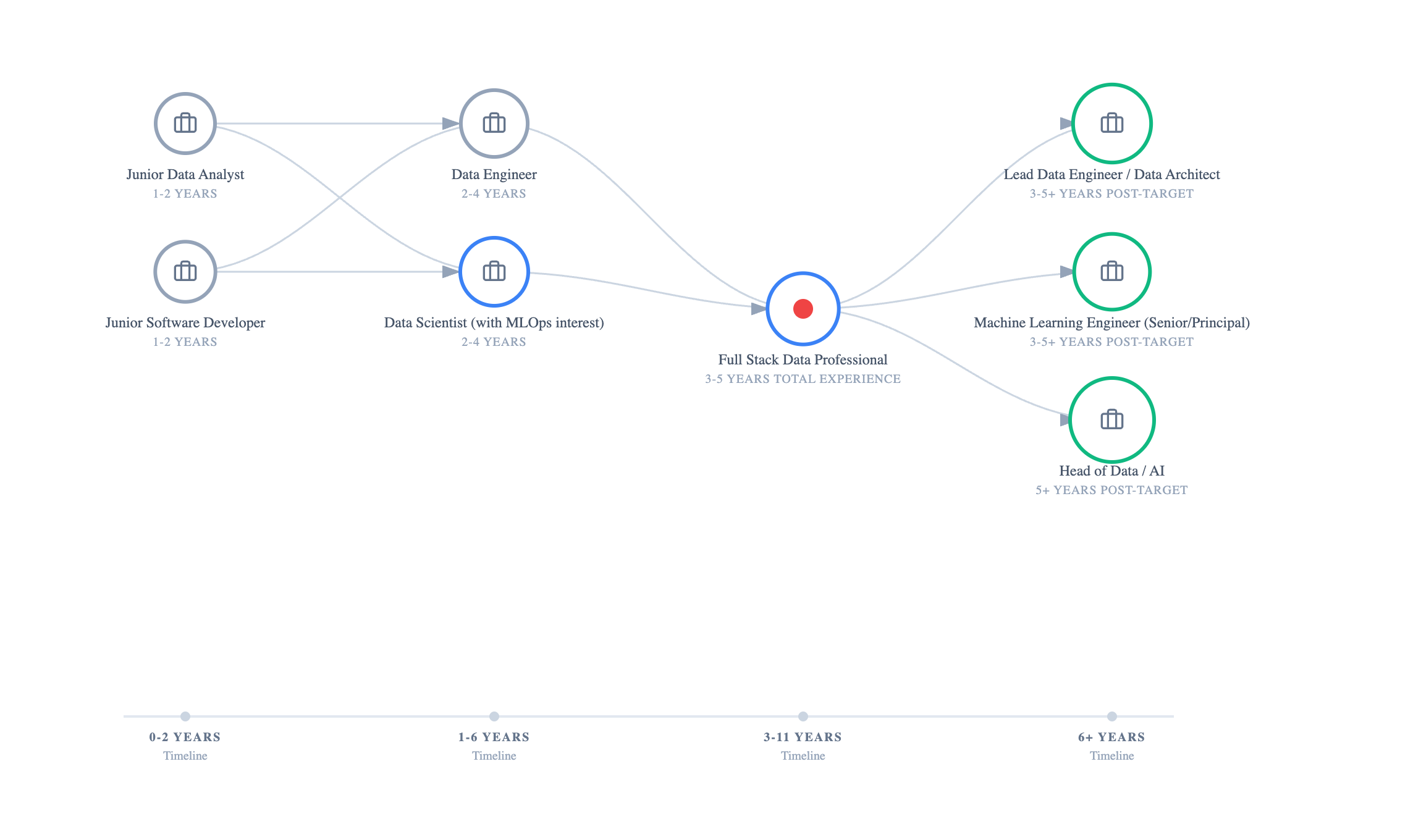
Explore the career path here in Aspiroo.
Imagine you’re building a house, but you have to hire one person just to hold the hammer, another to swing it, and a third to check if the nail went in straight. For the last decade, that has been the reality of the data world. We’ve carved out narrow, highly specialized silos: Data Engineers for the "plumbing," Data Scientists for the "math," and Data Analysts for the "storytelling".
While this specialization was necessary during the initial data explosion, it created a massive "coordination tax." Teams spent more time in meetings explaining requirements to each other than they did actually finding insights. In the 2026 economy, where efficiency is no longer optional, this old model is breaking down.
Enter the Full Stack Data Professional. This isn't a "unicorn" who knows every coding language ever invented; it’s a new breed of professional empowered by a revolutionary shift in how we interact with technology.
The End of the Wait-and-See Era
In the past, if a business leader asked a simple question like, "Why are our sales dropping in the Midwest?", the process was agonizing. The analyst had to ask the engineer to build a pipeline, who then had to ask the architect for permission. Weeks would pass before a single chart was created.
Today, the gap is being bridged by two major forces: Low-Code/No-Code (LCNC) platforms and a phenomenon called "Vibe Coding".
LCNC platforms have matured into "workflow copilots" that allow anyone with a good grasp of logic to drag and drop complex data systems into existence. Meanwhile, "Vibe Coding"—a term coined by Andrej Karpathy—has changed the game by making English the "hottest" new programming language.
Instead of writing 500 lines of complex Python code, a Full Stack professional can now describe the "vibe" of what they need: "Extract our daily sales from the cloud, flag any outliers, and send a summary to Slack." The AI handles the heavy lifting of the syntax, while the human focuses on the intent and the quality of the outcome.
Efficiency: From Months to Minutes
This isn't just a "cool tool" for developers; it’s a financial game-changer for organisations. When you remove the friction of handoffs between different teams, costs drop and speed skyrockets.
We’ve seen this in action at major enterprises. AT&T, for instance, moved away from specialised silos toward automated, integrated systems, allowing it to launch new internal solutions in days rather than months. Pfizer achieved something similar, saving 19,000 annual hours by unifying their data and empowering their teams to own the process end-to-end.
For a CEO, the "Full Stack" model means reducing the "sunk cost" of projects. In the old world, a failed six-month project was a disaster. In the vibe-coding era, a prototype that doesn't work can be pivoted or discarded in an afternoon, allowing for much cheaper and faster experimentation.
The Human Benefit: More Creative, Less Fatigued
Perhaps the most exciting part of this shift is what it does for you—the professional. For years, data experts have been bogged down by "data plumbing"—the tedious work of cleaning messy spreadsheets and fixing broken pipelines.
The Full Stack model uses AI to handle the routine, repetitive tasks, which research shows significantly reduces developer fatigue. It allows you to become a "Strategic Orchestrator." Instead of being "just an analyst," you become a trusted advisor who can not only spot a problem but also build the solution to fix it.
This diversification is a superpower in today's market. As entry-level roles face saturation, the demand is shifting toward those who can manage a project from the first data point to the final executive presentation. It’s an opportunity to move between industries—from healthcare to finance—because the core skill is no longer just "knowing the code," but "knowing how to solve the problem".
A New Career Roadmap
Becoming "Full Stack" in 2026 is about expanding your horizon. It starts with the foundations: curiosity and a solid understanding of your business. From there, it’s about learning to use these new "leverage points":
- Embrace the "Vibe": Learn to orchestrate AI agents to handle the technical grunt work.
- Understand the Flow: You don't need to be a plumber, but you should know how the pipes work. Learn the basics of how data moves from a source to a dashboard.
- Become a Storyteller: In a world where AI can build the chart, the human value lies in explaining why it matters.
Conclusion
The "Full Stack Data Professional" isn't just another job title; it’s a survival strategy for the future. By bridging the gap between engineering and insight, we’re not just making organisations more efficient—we’re making the work itself more human.
The era of waiting for "the data person" to get back to you is ending. The future belongs to those who can see the big picture, describe the vibe, and deliver the results.