The "Skill Earthquake": Why Human Judgment is the Career Moat
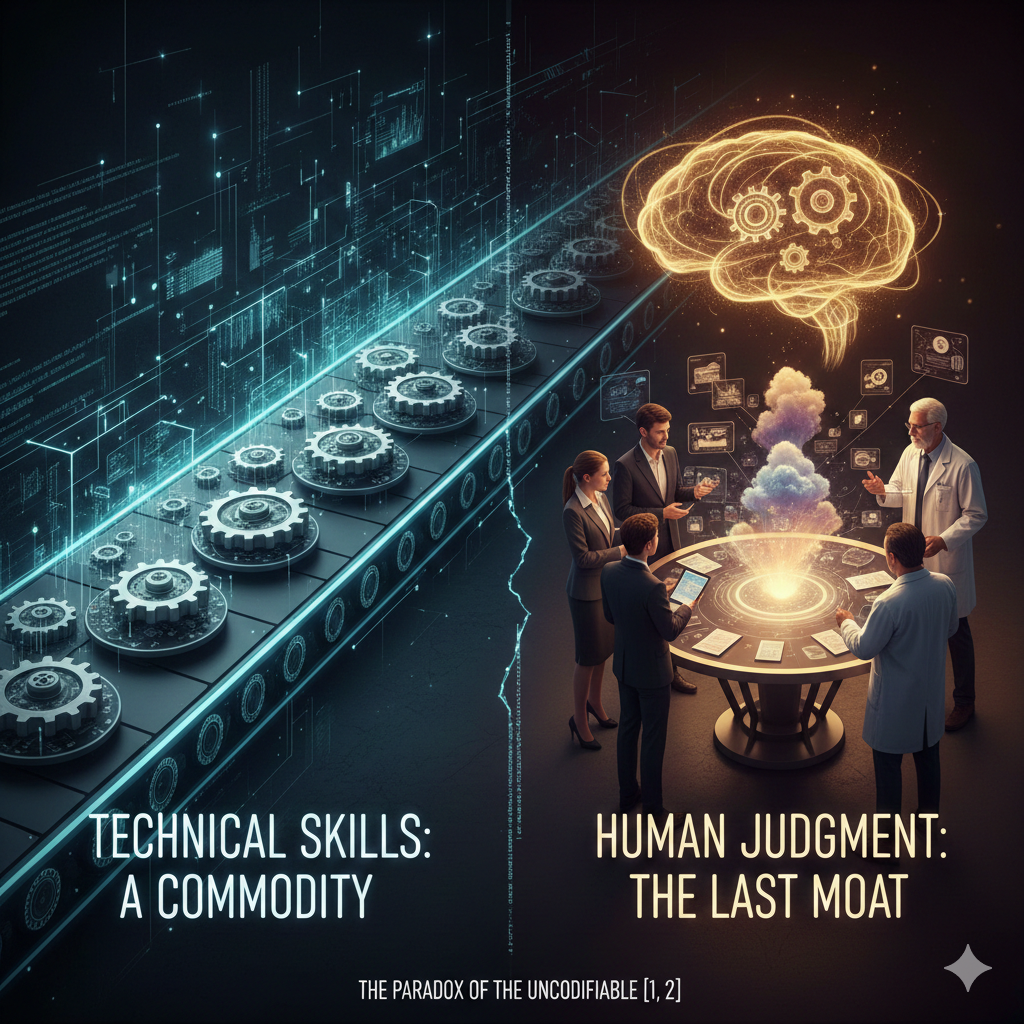
AI fluency has grown sevenfold in just two years, but technical skills are rapidly becoming a commodity. We are witnessing the Paradox of the Uncodifiable: the more we automate, the more we value the judgment that cannot be reduced to a set of rules. HR leaders report the widest talent gaps in problem-solving and navigating ambiguity—traits an algorithm simply cannot replicate. In high-stakes environments, this human oversight serves as a measurable efficiency lever that prevents massive downstream costs and errors. Technical fluency is now just the entry fee; your uncodifiable human judgment is the only career moat that lasts.
The global labour market is currently experiencing what researchers call a "skill earthquake," and the ground beneath our traditional career paths is shifting faster than most of us can keep up with. If you feel like the professional world has changed more in the last 24 months than in the previous decade, you aren't imagining it.
The demand for AI fluency—the ability to interact with and govern AI systems—has grown sevenfold in just two years. However, as we rush to add "Prompt Engineering" or "LLM Optimisation" to our resumes, we are missing the most critical trend of the decade: while AI fluency has become the "ticket to play," your human judgment has become the "ticket to win".
The Paradox of the "Uncodifiable"
Recent reports from HR professionals highlight a glaring contradiction. Even as technical AI skills surge in demand, companies are reporting the greatest difficulty in recruiting candidates with "soft" skills: problem-solving and critical thinking (37%), the ability to deal with complexity and ambiguity (32%), and complex communication (31%).
These skills are what experts call "uncodifiable". You cannot write a set of rules for an algorithm to follow that perfectly captures the nuance of a high-stakes negotiation, the ethical weight of a corporate pivot, or the empathy required to manage a team through a crisis.
In a world where 90% of digital content may be synthetically generated by 2026, the scarcity of genuine human perspective creates a "Human Premium". When technical execution drops toward zero marginal cost, the value shifts entirely to the one thing that cannot be automated: the Human Connection Moat.
Human Judgment as an Efficiency Lever
We often think of "human touch" as a luxury or a sentimental add-on. The data suggests otherwise. In modern enterprise architecture, human judgment is becoming a measurable efficiency lever.
In high-stakes environments—from autonomous mobility and healthcare to financial audits—every percentage point of accuracy gained through human-expert review saves high downstream costs in retraining, error correction, and failure mitigation. Companies that combine AI with human judgment are already outperforming their peers by up to 30% in talent retention and operational reliability.
If an AI makes a prediction, a human provides the cognition. As models grow more capable, the premium shifts from the execution of the task to the oversight of the outcome.
How to Build Your Personal Career Moat
If you want to future-proof your career in 2026, you must stop competing with the machine and start governing it. Here is how to build your moat:
1. Move from "Prediction" to "Judgment" AI excels at prediction—identifying patterns and suggesting the "next word" or "next step". Your value lies in the judgment phase: evaluating whether that prediction is ethical, contextually appropriate, and aligned with long-term strategy. If your job is purely repetitive, you are at risk. If your job involves "interpreting the exceptions," you are becoming indispensable.
2. Master "Expert-in-the-Loop" Workflows The future of work is a "Skill Partnership" between people, agents, and robots. Don't just use AI to draft emails; use it to synthesise data while you provide the "conscience and context". Professionals who can "reason, critique, and continuously refine" AI outputs are the ones being pushed up the value chain.
3. Double Down on Complexity and Ambiguity. Algorithms struggle with "jagged" ground—situations where rules are unclear or data is messy. Actively seek out projects that require navigating ambiguity or managing multi-stakeholder relationships. These interpersonal skills are expected to see a 24% growth in demand by 2030, while basic cognitive skills are projected to decline by 15%.
4. Practice "Radical Transparency" In a synthetic age, trust is the most fragile currency. Whether you are a leader or an individual contributor, be transparent about where AI ends and your judgment begins. Brands and individuals who maintain a "human voice"—unpolished at times but unmistakably real—will win the attention economy.
The Bottom Line
The "skill earthquake" is not here to replace us; it is here to clarify our value. As technology handles the speed and scale, we are being called back to our core strengths: intuition, ethics, and connection.
The most successful professionals of the next decade will not be the ones with the cleverest prompts, but the ones who use those prompts to "remove the drudgery" so they can show up where it counts: in the high-stakes moments that require a human heart and a human mind.
Your judgment isn't just a "soft skill" anymore. It is your most powerful economic defence. Build your moat accordingly.