Why AI, Data and Tech are the New Survival Skills
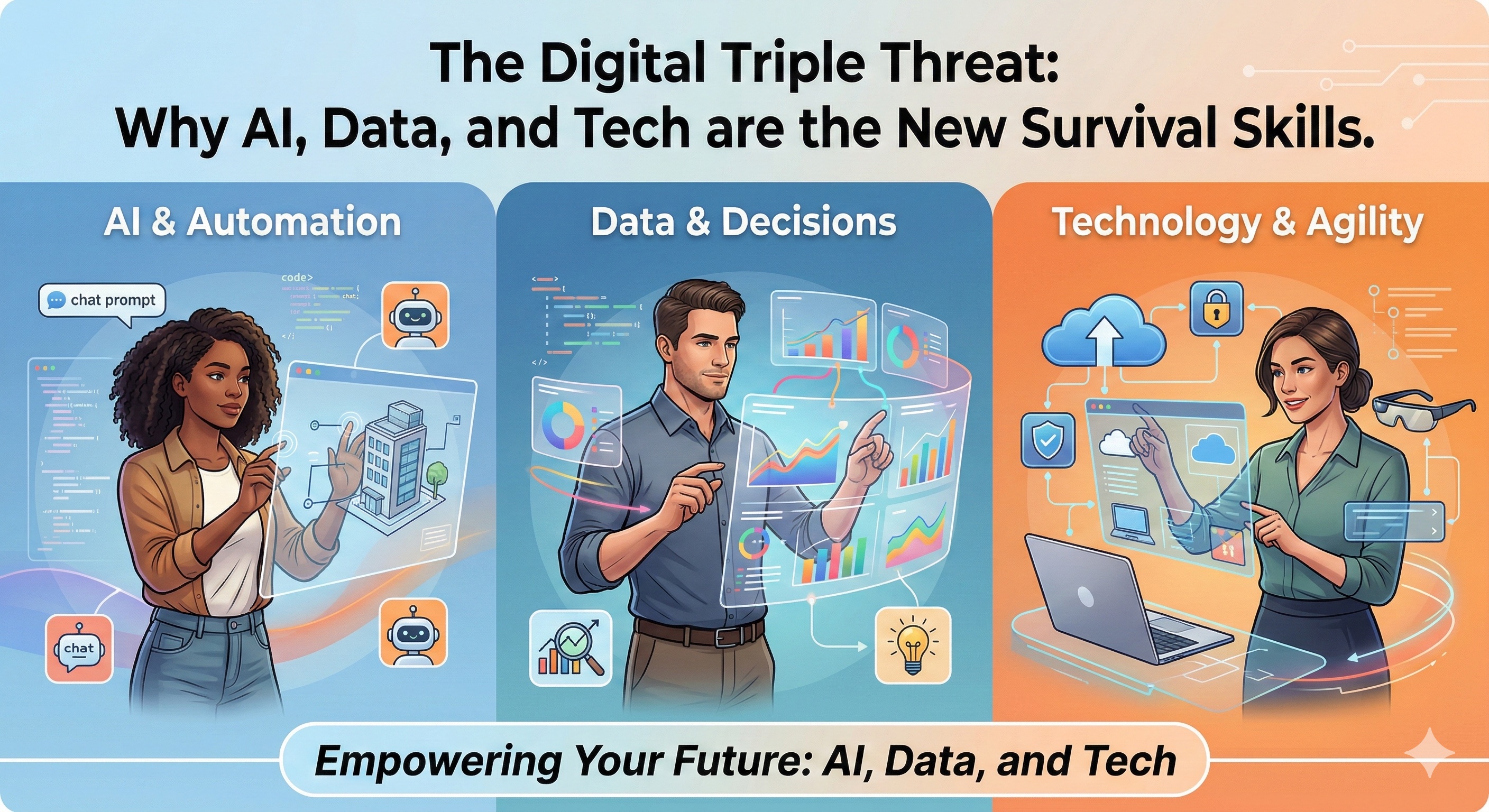
In today's fast-paced world, mastering AI, data, and technology is no longer just for "techies" - it is the new baseline for professional literacy across every industry. These tools act as power-ups that handle repetitive "drudge work," provide evidence for better decision-making, and ensure you remain adaptable as software evolves. By embracing this digital triple threat, you offload mechanical tasks to machines so you can focus on the uniquely human skills that truly drive value.
For decades, the professional world was divided into two camps: the "techies" and everyone else. If you worked in marketing, HR, healthcare, or the trades, technology was something the IT department handled. You did your job, and they made sure the email worked.
That wall has officially crumbled. We have entered an era where Artificial Intelligence (AI), Data Literacy, and General Technology are no longer niche skills reserved for Silicon Valley. They have become the fundamental "literacy" of the modern workforce. Whether you are a barista, a barrister, or a biologist, understanding these three pillars is the difference between steering the ship and being left at the dock.
AI: From Science Fiction to Your New Coworker
There is a common fear that AI is coming for our jobs. While it’s true that automation is changing the landscape, the more accurate reality is that AI is changing the nature of tasks.
Think of AI as a "force multiplier." In the past, a lawyer might spend twenty hours scouring thousands of documents for a single specific clause. Today, an AI can do that in seconds, allowing the lawyer to spend those twenty hours on high-level strategy and client advocacy. In this scenario, the AI didn't replace the lawyer; it removed the "busy work."
Every professional needs to learn AI because it is becoming the primary interface for productivity. Learning how to "prompt" an AI, understand its limitations, and verify its outputs is becoming as essential as knowing how to send an email. If you can harness AI to do the heavy lifting of drafting, researching, and organizing, you free up your human brain for what it does best: creativity, empathy, and complex problem-solving.
Data: The New Universal Language
We often think of "data" as rows of boring numbers in an Excel spreadsheet, but data is actually just information in context. Every time a customer buys a product, a patient checks into a hospital, or a student completes a quiz, data is created.
In the modern workplace, "because I have a hunch" is no longer a valid justification for a business decision. Companies now demand evidence. If you can look at a set of numbers and see a story—identifying that sales drop on rainy Tuesdays or noticing that a specific surgical procedure has a higher recovery rate—you become a strategic asset.
Data literacy allows you to speak the "language of proof." It gives you the power to advocate for your ideas, measure your own success, and spot problems before they become disasters. You don't need to be a mathematician; you just need to be able to ask the right questions of the information in front of you.
Technology: Building Your Digital Resilience
General "technology" is the foundation that holds AI and Data together. This isn't just about knowing how to use a specific app; it’s about technological fluency.
The tools we use are changing faster than ever. If you only learn "how to use Software X," you are at risk the moment Software X is replaced by Software Y. However, if you understand the underlying logic—how cloud computing works, how different apps "talk" to each other through APIs, and how to troubleshoot basic digital hurdles—you become resilient.
Technological fluency means you aren't intimidated by change. When your company moves to a new project management platform or introduces a digital inventory system, you won't be the one struggling to keep up. You’ll be the one leading the transition.
The Human Advantage
The irony of the digital revolution is that as we get better at using machines, uniquely human skills become more valuable. AI cannot feel empathy; data cannot provide moral judgment; and technology cannot build a personal relationship.
By mastering the "Digital Triple Threat," you offload the mechanical and analytical tasks to the machines, which gives you the space to double down on your humanity. You become a professional who is not only technically capable but also strategically minded and emotionally intelligent.
The goal isn't to become a robot. The goal is to use the tools available so you can be the most effective, creative, and empowered version of yourself. The future belongs to those who aren't afraid to pick up the tools and start building.