Manual Testing to Automation: The Step Before Selenium Nobody Sells You
Manual testers switching to automation are usually sold a 3–6 month "just learn Selenium" timeline. The article argues that's misleading: Aspiroo's own career-ladder data shows the real bottleneck isn't the testing tool, it's a missing layer of basic programming (data structures, OOP, Git, SQL) that Entry-Level Developers already have but Manual Testers typically don't. Course ads skip straight to Selenium because that's what they're selling. It lays out the honest stage-by-stage path and pay bands (Manual Tester → QA Automation Tester → Automation Engineer → Senior/SDET/Architect), cites a dated external stat (SoftwareTestPilot's QA Job Market Report 2026) on pay outcomes for testers who add automation skills, and splits advice for testers early in their career (build the programming foundation first) versus those 3+ years in (move internally to protect seniority rather than restart as a junior).
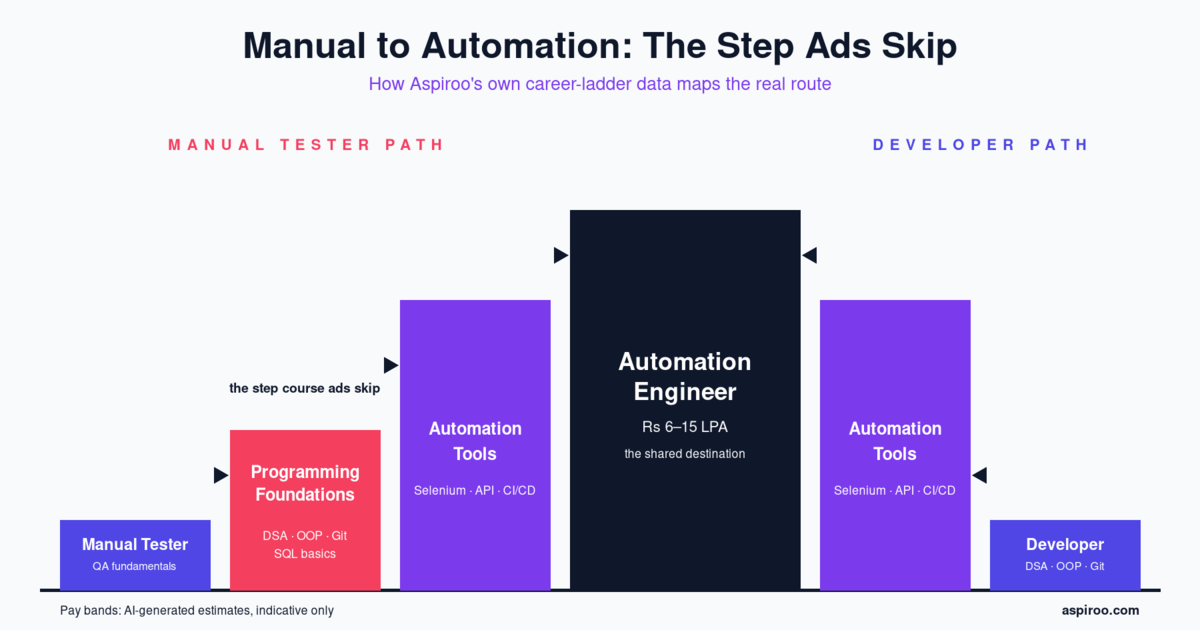
If you're a manual tester in India asking how to move into automation, the honest answer is that Selenium is not the hard part. The hard part is a layer of plain programming ability that most manual testers were never asked to build — and that course ads quietly assume you already have when they promise a three-month switch.
Aspiroo's own Automation Engineer career path makes this visible in a way most guides don't, because of how the ladder is actually structured. There are two separate entry doors into the same mid-level automation role, and they do not start from the same place. One of them is a much longer walk than the other — and it's the one most manual testers are standing behind.
Two doors, one destination
Aspiroo's data maps two distinct entry-level roles that both feed into the same mid-level stage, QA Automation Tester:
- Junior QA Engineer / Manual Tester (₹2.5–5 LPA): manual testing, test case design, bug tracking, STLC, basic SQL.
- Entry-Level Software Developer (₹3–6 LPA): a programming language, data structures and algorithms, Git, object-oriented programming, database fundamentals.
Only one of these paths has a documented "Moving Between Stages" entry to QA Automation Tester in Aspiroo's ladder data, and it starts from the developer side. The listed new skills for that jump — Selenium WebDriver, Python or Java for automation, TestNG or JUnit, API testing, test frameworks — are exactly the skills every "learn Selenium" course sells you. What that course doesn't mention is that the entry-level developer already walks in with data structures, OOP, Git and database fundamentals underneath those tools. A manual tester, by the ladder's own skill list, walks in with none of it.
That is the actual gap. Not a testing-tool gap — a programming-foundation gap that sits underneath the tool.
What "just add Selenium" leaves out
This is where most transition guides oversell the timeline. A widely shared 2026 guide promises a four-month roadmap and claims most manual testers switch in four to six months with daily practice — sometimes two to three months for people who "have a programming background." That qualifier is doing all the work, and it's usually dropped from the headline.
If you already have a programming background, you're not really starting from Junior QA Engineer / Manual Tester — you're starting from something closer to Entry-Level Software Developer, and the shorter timeline is real for you. If you don't, the honest sequence has an extra stage in it: basic programming fundamentals first (variables, control flow, OOP, Git, a bit of database work), then Selenium, TestNG, and API testing on top of that foundation. Compressing both into one three-month sprint is how people end up with a GitHub repo of copied Selenium scripts they can't explain in an interview — which is precisely what technical screens for automation roles are built to catch.
The realistic timeline, stage by stage
Using Aspiroo's India bands for the Automation Engineer path:
| StageBand (INR)Typical time | ||
| Junior QA Engineer / Manual Tester | 2.5–5 LPA | 1–2 years |
| QA Automation Tester | 4–8 LPA | 2–3 years |
| Automation Engineer (target role) | 6–15 LPA | 2–4 years |
| Senior / Lead Automation Engineer | 10–20 LPA | 3–5 years |
| SDET | 10–22 LPA | 3–5 years |
| Automation Architect | 18–35 LPA | 5+ years |
All salary figures here are AI-generated estimates informed by market data. They are indicative bands for planning, not survey-grade numbers.
Read plainly: the jump from manual tester to QA Automation Tester is not a weekend project, and the ladder doesn't pretend otherwise. Building the programming foundation properly, then the automation toolkit on top of it, realistically runs closer to nine to eighteen months for someone starting with no coding background — not the three-to-four months sold on landing pages. If you already code a little, or you studied CS, the shorter timeline genuinely applies to you. The question worth asking yourself honestly before you enrol in anything is which of those two people you actually are.
What the market data says about waiting
This isn't a reason to stay purely manual. SoftwareTestPilot's QA Job Market Report, built from over 10,000 live QA postings across LinkedIn, Naukri, Indeed and Glassdoor between June and July 2026, found that 38% of QA job listings that year still hire manual testers — but nearly all of them now list API testing, SQL and basic automation literacy as required or preferred. The same report found that manual testers who add an automation tool plus API testing typically move into roles paying roughly double what a pure-manual role tops out at in India (SoftwareTestPilot, QA Job Market Report 2026, data aggregated June–July 2026).
The direction is real. What's not real is the timeline course marketing attaches to it.
If you're 0–2 years into manual testing
Your advantage is time, not speed. Spend real weeks on programming fundamentals before you touch Selenium — data structures, loops, functions, a bit of Git. It's slower up front and much faster overall, because every automation tutorial you watch afterwards will actually make sense instead of being a script you're copying blind. Manual testing itself is not a detour here; STLC and bug-lifecycle knowledge from Aspiroo's own entry-level skill list carry forward directly into how you decide what's worth automating later.
If you're 3+ years in, already senior on the manual side
Your risk is different: arriving in an automation role as a junior all over again, wiping out years of seniority. The stronger move is often internal — build automation scripts inside your current QA role, on your current company's product, before changing employers. That protects your title and band while you close the skill gap, and it lets you walk into your first Automation Engineer interview with a working framework you built on real production features, not a SauceDemo clone. Domain knowledge — knowing the product, the edge cases, the release process — is worth more at this stage than it gets credit for, and it's the one thing a fresher automation candidate can't match.
The one-line version
The tool isn't the gap. The programming foundation underneath the tool is — and how long your transition actually takes depends entirely on whether you're building that foundation from zero or already have it. Budget for the honest version, not the landing-page version, and the switch holds up.