How to Become a Automation Engineer in India
The Automation Engineer career in India is experiencing robust growth, driven by the digital transformation initiatives across various sectors like IT, manufacturing, finance, and telecommunications. Companies are increasingly investing in automating repetitive tasks, testing processes, and infrastructure management to improve efficiency, reduce errors, and accelerate time-to-market. This role demands a blend of strong programming skills, an understanding of testing methodologies, and proficiency with automation tools and frameworks, making it a pivotal role in the modern software development lifecycle.
Explore this path interactively Share this ladder
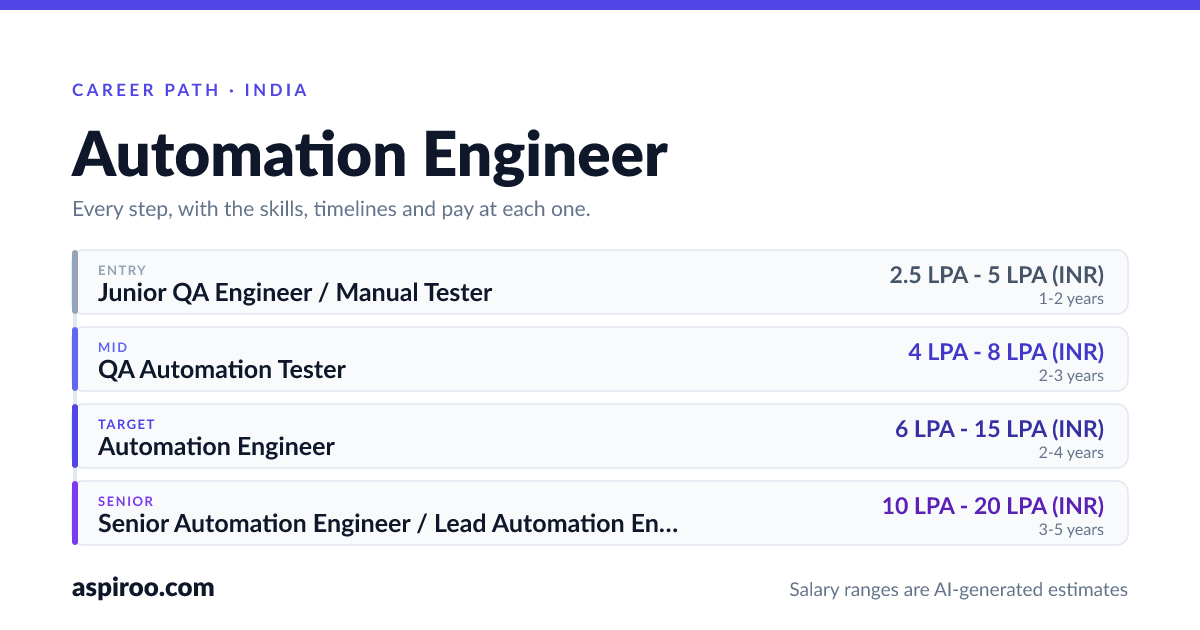
Career Progression
Entry Level
Junior QA Engineer / Manual Tester
Performs manual testing, develops test cases, reports bugs, and ensures software quality based on requirements. Focuses on understanding the software development and testing lifecycles.
2.5 LPA - 5 LPA (INR) · 1-2 years
Skills: Manual Testing, Test Case Design, Bug Tracking (Jira), Software Testing Life Cycle (STLC), SQL Basics
Entry-Level Software Developer
Develops, tests, and deploys software applications under supervision. Gains foundational programming skills and understanding of system design.
3 LPA - 6 LPA (INR) · 1-2 years
Skills: Python/Java/C#, Data Structures & Algorithms, Git, Object-Oriented Programming (OOP), Database Fundamentals
Mid Level
QA Automation Tester
Responsible for designing, developing, and executing automated test scripts using various tools and frameworks. Focuses primarily on functional and regression test automation.
4 LPA - 8 LPA (INR) · 2-3 years
Skills: Selenium WebDriver, Python/Java for Automation, TestNG/JUnit, API Testing (Postman/Rest Assured), Git, Test Frameworks
Target Role
Automation Engineer
Designs, implements, and maintains robust automation solutions across the software development lifecycle, including testing, deployment, and infrastructure. Integrates automation into CI/CD pipelines.
6 LPA - 15 LPA (INR) · 2-4 years
Skills: Test Framework Design & Architecture, CI/CD Pipelines (Jenkins/GitLab CI), Cloud Basics (AWS/Azure/GCP), Performance Testing (JMeter), Scripting (Bash/PowerShell), Docker/Kubernetes Basics
Senior / Leadership
Senior Automation Engineer / Lead Automation Engineer
Leads the design and implementation of complex automation frameworks. Mentors junior team members, defines automation strategy, and ensures best practices are followed across projects.
10 LPA - 20 LPA (INR) · 3-5 years
Skills: Architecting Automation Frameworks, Strategic Planning, Mentorship, Performance & Security Automation, BDD/TDD Practices, Scalable Automation Solutions
DevOps Engineer
Bridges the gap between development and operations by automating and streamlining the entire software delivery pipeline. Focuses on continuous integration, continuous delivery, and infrastructure as code.
12 LPA - 25 LPA (INR) · 3-5 years
Skills: Docker, Kubernetes, Terraform, Ansible, Cloud Platforms (AWS/Azure/GCP), Monitoring (Prometheus/Grafana), CI/CD Toolchains
SDET (Software Development Engineer in Test)
A hybrid role blending development and testing expertise. SDETs are responsible for writing code, building test automation frameworks, and contributing to the overall quality and design of the product from a developer's perspective.
10 LPA - 22 LPA (INR) · 3-5 years
Skills: Strong Programming (Java/Python/C#), Data Structures & Algorithms, System Design, Building Custom Test Tools, Performance Engineering, Unit/Integration Testing
Automation Architect
Defines the overall automation strategy, vision, and roadmap for an organization. Evaluates and selects tools, designs enterprise-level frameworks, and provides technical leadership to multiple automation teams.
18 LPA - 35 LPA (INR) · 5+ years
Skills: Enterprise Automation Strategy, AI/ML in Testing, Budget Management, Stakeholder Communication, Tool Evaluation & Selection, Industry Best Practices
Moving Between Stages
Entry-Level Software Developer to QA Automation Tester
Moving from Entry-Level Software Developer to QA Automation Tester in India is a change in scope, not just a title. The skills that are genuinely new at this step are Selenium WebDriver, Python/Java for Automation, TestNG/JUnit, API Testing (Postman/Rest Assured), Test Frameworks — everything else you already use in Entry-Level Software Developer. People typically spend 2-3 years in QA Automation Tester once they get there. Pay moves from 3 LPA - 6 LPA (INR) to 4 LPA - 8 LPA (INR).
QA Automation Tester to Automation Engineer
Moving from QA Automation Tester to Automation Engineer in India is a change in scope, not just a title. The skills that are genuinely new at this step are Test Framework Design & Architecture, CI/CD Pipelines (Jenkins/GitLab CI), Cloud Basics (AWS/Azure/GCP), Performance Testing (JMeter), Scripting (Bash/PowerShell), Docker/Kubernetes Basics — everything else you already use in QA Automation Tester. People typically spend 2-4 years in Automation Engineer once they get there. Pay moves from 4 LPA - 8 LPA (INR) to 6 LPA - 15 LPA (INR).
Automation Engineer to Senior Automation Engineer / Lead Automation Engineer
Moving from Automation Engineer to Senior Automation Engineer / Lead Automation Engineer in India is a change in scope, not just a title. The skills that are genuinely new at this step are Architecting Automation Frameworks, Strategic Planning, Mentorship, Performance & Security Automation, BDD/TDD Practices, Scalable Automation Solutions — everything else you already use in Automation Engineer. People typically spend 3-5 years in Senior Automation Engineer / Lead Automation Engineer once they get there. Pay moves from 6 LPA - 15 LPA (INR) to 10 LPA - 20 LPA (INR).
Automation Engineer to DevOps Engineer
Moving from Automation Engineer to DevOps Engineer in India is a change in scope, not just a title. The skills that are genuinely new at this step are Docker, Kubernetes, Terraform, Ansible, Cloud Platforms (AWS/Azure/GCP), Monitoring (Prometheus/Grafana) — everything else you already use in Automation Engineer. People typically spend 3-5 years in DevOps Engineer once they get there. Pay moves from 6 LPA - 15 LPA (INR) to 12 LPA - 25 LPA (INR).
Automation Engineer to SDET (Software Development Engineer in Test)
Moving from Automation Engineer to SDET (Software Development Engineer in Test) in India is a change in scope, not just a title. The skills that are genuinely new at this step are Strong Programming (Java/Python/C#), Data Structures & Algorithms, System Design, Building Custom Test Tools, Performance Engineering, Unit/Integration Testing — everything else you already use in Automation Engineer. People typically spend 3-5 years in SDET (Software Development Engineer in Test) once they get there. Pay moves from 6 LPA - 15 LPA (INR) to 10 LPA - 22 LPA (INR).
Skills You Need
Manual Testing · Test Case Design · Bug Tracking (Jira) · Software Testing Life Cycle (STLC) · SQL Basics · Python/Java/C# · Data Structures & Algorithms · Git · Object-Oriented Programming (OOP) · Database Fundamentals · Selenium WebDriver · Python/Java for Automation · TestNG/JUnit · API Testing (Postman/Rest Assured) · Test Frameworks · Test Framework Design & Architecture · CI/CD Pipelines (Jenkins/GitLab CI) · Cloud Basics (AWS/Azure/GCP) · Performance Testing (JMeter) · Scripting (Bash/PowerShell) · Docker/Kubernetes Basics · Architecting Automation Frameworks · Strategic Planning · Mentorship
Common Questions
How do I become a Automation Engineer in India?
Most people reach Automation Engineer in India by starting in a role such as Junior QA Engineer / Manual Tester or Entry-Level Software Developer, then moving through mid-level positions before taking the Automation Engineer title. Early on, the skills that matter most are Manual Testing, Test Case Design, Bug Tracking (Jira), Software Testing Life Cycle (STLC), SQL Basics.
How long does it take to become a Automation Engineer?
Typically several years across multiple stages. Each step on the path takes roughly 1-2 years, 2-3 years, 2-4 years, so the full journey from entry level to Automation Engineer usually spans a number of years rather than months. Moving faster generally means taking on scope earlier, not skipping stages.
What is the salary of a Automation Engineer in India?
A Automation Engineer in India typically earns 6 LPA - 15 LPA (INR). Entry-level roles on this path start around 2.5 LPA - 5 LPA (INR). Senior and leadership roles reach 10 LPA - 20 LPA (INR).
What skills do you need to be a Automation Engineer?
The core skills for a Automation Engineer are Test Framework Design & Architecture, CI/CD Pipelines (Jenkins/GitLab CI), Cloud Basics (AWS/Azure/GCP), Performance Testing (JMeter), Scripting (Bash/PowerShell), Docker/Kubernetes Basics. The skills that get you promoted into the role are not the same as the ones that advance you beyond it — later stages weight judgment and business impact more heavily than tools.
What comes after Automation Engineer?
Common next steps are Senior Automation Engineer / Lead Automation Engineer, DevOps Engineer, SDET (Software Development Engineer in Test) or Automation Architect. The path forks here: some move deeper into technical specialisation, others into people management, and the two lead to very different day-to-day work.
Is Automation Engineer a good career in India?
The Automation Engineer career in India is experiencing robust growth, driven by the digital transformation initiatives across various sectors like IT, manufacturing, finance, and telecommunications. Companies are increasingly investing in automating repetitive tasks, testing processes, and infrastructure management to improve efficiency, reduce errors, and accelerate time-to-market. This role demands a blend of strong programming skills, an understanding of testing methodologies, and proficienc
How do you move from Entry-Level Software Developer to QA Automation Tester?
Moving from Entry-Level Software Developer to QA Automation Tester in India is a change in scope, not just a title. The skills that are genuinely new at this step are Selenium WebDriver, Python/Java for Automation, TestNG/JUnit, API Testing (Postman/Rest Assured), Test Frameworks — everything else you already use in Entry-Level Software Developer. People typically spend 2-3 years in QA Automation Tester once they get there. Pay moves from 3 LPA - 6 LPA (INR) to 4 LPA - 8 LPA (INR).
How do you move from QA Automation Tester to Automation Engineer?
Moving from QA Automation Tester to Automation Engineer in India is a change in scope, not just a title. The skills that are genuinely new at this step are Test Framework Design & Architecture, CI/CD Pipelines (Jenkins/GitLab CI), Cloud Basics (AWS/Azure/GCP), Performance Testing (JMeter), Scripting (Bash/PowerShell), Docker/Kubernetes Basics — everything else you already use in QA Automation Tester. People typically spend 2-4 years in Automation Engineer once they get there. Pay moves from 4 LPA - 8 LPA (INR) to 6 LPA - 15 LPA (INR).
How do you move from Automation Engineer to Senior Automation Engineer / Lead Automation Engineer?
Moving from Automation Engineer to Senior Automation Engineer / Lead Automation Engineer in India is a change in scope, not just a title. The skills that are genuinely new at this step are Architecting Automation Frameworks, Strategic Planning, Mentorship, Performance & Security Automation, BDD/TDD Practices, Scalable Automation Solutions — everything else you already use in Automation Engineer. People typically spend 3-5 years in Senior Automation Engineer / Lead Automation Engineer once they get there. Pay moves from 6 LPA - 15 LPA (INR) to 10 LPA - 20 LPA (INR).
How do you move from Automation Engineer to DevOps Engineer?
Moving from Automation Engineer to DevOps Engineer in India is a change in scope, not just a title. The skills that are genuinely new at this step are Docker, Kubernetes, Terraform, Ansible, Cloud Platforms (AWS/Azure/GCP), Monitoring (Prometheus/Grafana) — everything else you already use in Automation Engineer. People typically spend 3-5 years in DevOps Engineer once they get there. Pay moves from 6 LPA - 15 LPA (INR) to 12 LPA - 25 LPA (INR).
Related Career Paths
- Software Engineer
- Full-Stack Developer
- Android Developer
- iOS Developer
- Java Developer
- Enterprise Architect