Career Options After 12th: Five Routes Beyond Engineering and Medicine, and What Each Actually Pays Over Time
First jobs outside engineering and medicine pay within a couple of lakh of each other. The gap opens years later, and one route hides an MBA gate exactly where the pay jumps. Here is how to read a ladder before you pick a degree.
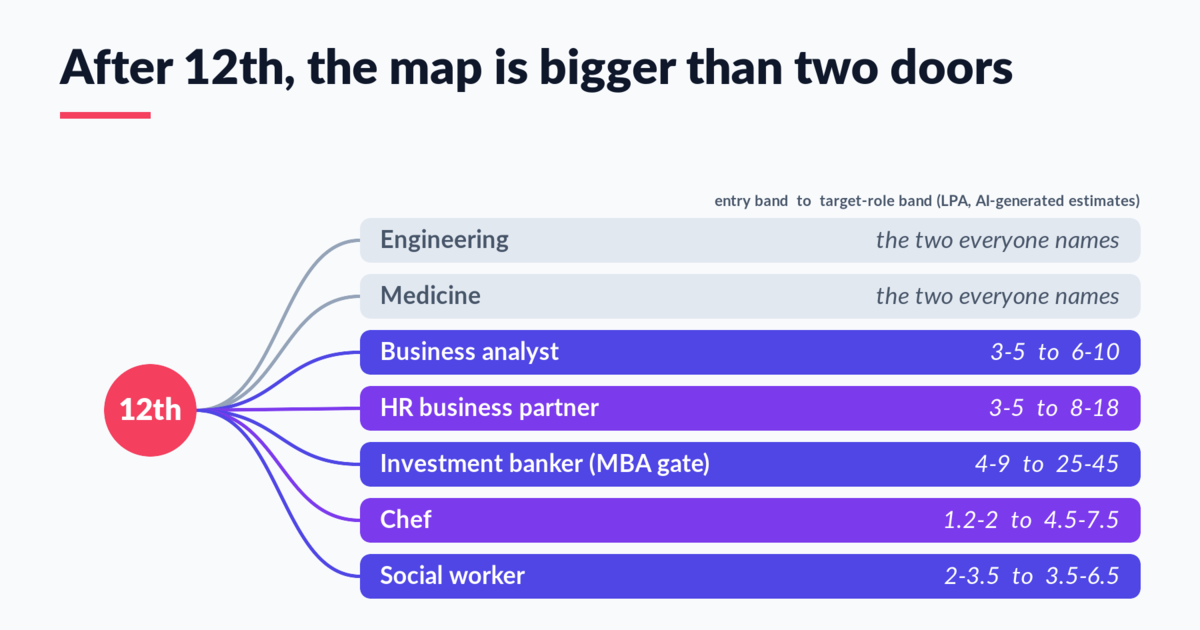
If you want a career after 12th that isn't engineering or medicine, five well-worn routes are worth a serious look: business analysis, investment banking, HR, professional cooking, and social work. They are not equally easy and they do not pay the same, but the surprise in Aspiroo's career-ladder data is how similar they look at the start. First-job pay in all five sits in roughly the same ₹1.2–9 LPA range. What separates them is how long the ladder is, whether there is a gate on the way up (one has an MBA gate), and where the ceiling sits.
That is the thing most "options after 12th" lists leave out. The ones we read gave you a menu of fields and nothing about what year five or year ten looks like. This post gives you the ladder.
The two-door picture is already wrong
Engineering and medicine feel like the default because the numbers around them are enormous. Careers360 News reports that 22,79,743 candidates registered for NEET UG 2026, of whom 19,99,895 appeared and 11,21,185 qualified. But the other door is not small either: 15,68,867 candidates registered for CUET UG 2026, the common entrance for many central and participating university programmes in arts, commerce, science and more, and 11,64,098 appeared (NTA, reported by IANS, 23 June 2026).
Millions of students every year are, in other words, already choosing something other than a medical seat. The question is whether they are choosing with information.
Read the ladder, not the course brochure
A degree name tells you very little. What matters is the sequence of jobs it opens: what you are called in year one, what you are called in year eight, and what each stage typically pays.
A note on the numbers. All salary figures in this post are AI-generated estimates informed by market data. They are indicative bands for planning, not survey-grade numbers, and real offers vary by city, employer and year.
Here are five routes, using the stage data on Aspiroo's career pages for India:
| Projected Roles | ||||
| Business analyst | ₹3–5 LPA (Associate Analyst) | ₹6–10 LPA | ₹9–15 LPA (Senior BA) | Needs SQL and documentation skills early |
| HR business partner | ₹3–5 LPA (HR Coordinator) | ₹8–18 LPA | ₹15–25 LPA (Senior HRBP) | Target role sits at roughly 4–7 years of experience |
| Investment banker | ₹4–9 LPA (Financial Analyst) | ₹25–45 LPA (Associate) | ₹40–80 LPA (VP) | Associate role asks for an MBA or significant experience |
| Chef | ₹1.2–2 LPA (Kitchen Helper) | ₹4.5–7.5 LPA (Chef de Partie) | ₹18–35+ LPA (Executive Chef) | Five stages before Chef de Partie; low early pay |
| Social worker | ₹2–3.5 LPA (Field Investigator) | ₹3.5–6.5 LPA | ₹9–18+ LPA (Consultant, 8+ years) | Highest ceiling arrives late and needs policy skills |
Read the first two columns and the routes look interchangeable. Read the last three and they are completely different careers.
The five routes, honestly
Business analysis is the most forgiving door. The ladder runs from Associate Analyst through Junior Business Analyst and Systems Analyst to the target role, and then forks: Senior BA, Product Owner, Project Manager or Business Consultant, each with its own band. It rewards people who like structuring messy problems, and it does not care much which degree you came in with, as long as you can write SQL and document requirements. If you later want product work, our piece on what changes between business analyst and product manager maps the next step.
HR looks soft from outside and is more structured than people expect. The ladder moves from HR Coordinator to HR Executive and HR Generalist before the HR Business Partner role, which Aspiroo's data places at about four to seven years of total experience. The page also notes that the Indian market prizes formal HR education and recognised certifications, so a relevant degree and a credential both help. The reward is the upper end: HR Manager bands reach ₹18–30 LPA and large-organisation HR heads go higher.
Investment banking has the biggest numbers and the narrowest door. The jump from Investment Banking Analyst (₹10–25 LPA) to Associate (₹25–45 LPA) is where the ladder asks for an MBA or significant related experience. If finance is the draw, the realistic early move is often through Financial Analyst or Equity Research Analyst, which are listed as entry roles in the same ladder. Plan for the gate, not just the destination.
Professional cooking is the route where honesty matters most. The Chef ladder has five stages before Chef de Partie (Kitchen Helper, Commis 3, Commis 2, Commis 1, Demi Chef de Partie), and early bands start at ₹1.2–2 LPA. The ceiling is real, with Executive Chef at ₹18–35+ LPA, but it takes a long time and a physical working life to get there. Choose it because you want to cook, not because a brochure said "hospitality is booming".
Social work and development has the lowest early pay and a ceiling that arrives late: Program Manager (NGO/CSR) at ₹7–12 LPA after five to eight years, and Consultant (Social Development) at ₹9–18+ LPA at eight years and beyond. It suits people who would do the work for less and want the money to grow with policy and programme skills.
If you are in class 12 right now
Do three things before you choose a course. First, pick two routes from the table and write down the stage you would be in at ages 22, 27 and 32. If you cannot name the jobs, you are choosing a degree, not a career. Second, check the gate: does your route need a postgraduate degree, a certification or a particular exam at a specific point? Third, ask what you would be doing on an ordinary Tuesday in the target role, not on the first day of the course.
Do not treat the choice as permanent. Ladders like these intersect: a business analyst can become a product owner, an HR professional can move into people analytics, a finance analyst can end up in corporate development. Our broader idea of the career lattice is that the first choice sets your starting point, not your destination.
If you are a parent reading this
The most useful question to ask your child is not "which course has scope?" but "which job do you want in year eight, and what does the path to it cost?". A route with low early pay and a high ceiling, like cooking or social work, can be right for the right child, but it needs a family that expects the slow years. A route with a gate, like investment banking, needs the budget and time for the next degree planned in advance.
What to do this month
Pick the two routes that sound most like you, open their ladder pages, and read the "Moving Between Stages" section on each. Then talk to one person who is five years into each. If neither route survives that conversation, you have lost a month and saved a degree. If one does, you will know your first-year goals before your admission form is due.
Aspiroo's ladders are a planning aid: salary bands are AI-generated estimates and entry requirements should be checked against the institution and employer you are actually applying to.