Non-CS Graduate into Tech: Four Routes That Work in India, and the Free Way to Learn Each One
The fastest route into tech for a non-CS graduate is not the software route at all, and the slowest has the highest ceiling. Here is how years and pay compare across four doors, plus the free videos and AI tutors that cover the skills.
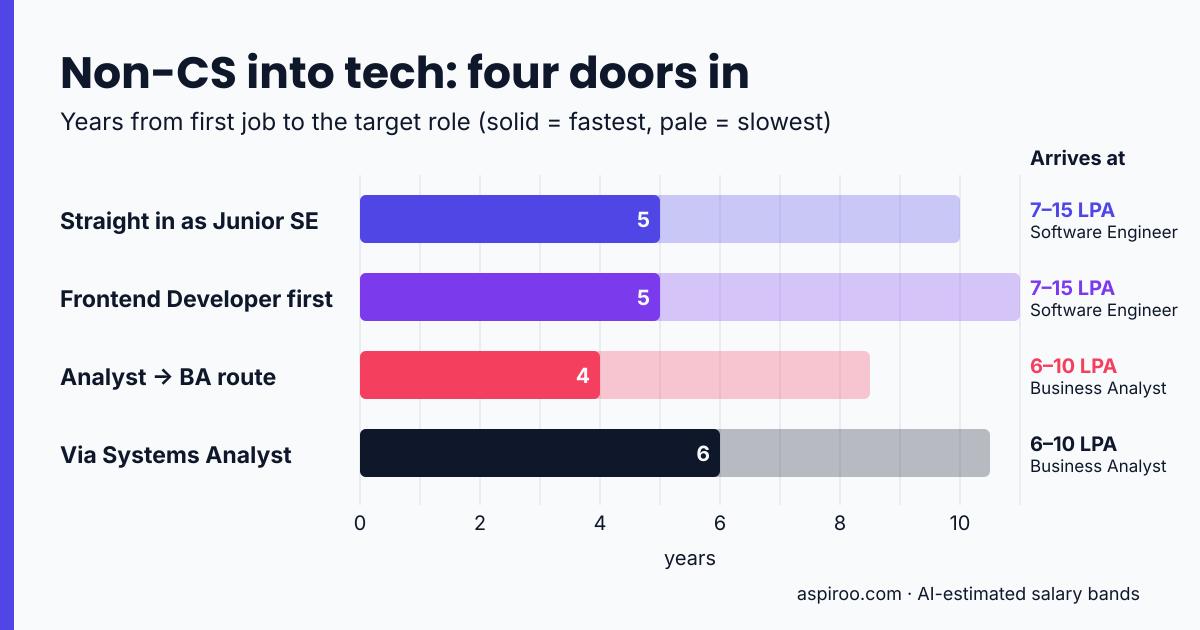
If you did not study computer science and want a software job in India, the routes that work are these four: start as a Junior Software Engineer, start as a Frontend Developer, start as an analyst and move into business analysis, or go through Systems Analyst as a bridge. On Aspiroo's career ladders, they reach a target role in roughly four to eleven years, at an estimated 6–15 LPA, depending on which door you choose. The fastest is not the one with the highest ceiling. The teaching for every one of them is now free, through YouTube, NPTEL and AI tutors. What you are short of is the order to learn things in and a clear picture of where each stage leads.
The guides that rank for this query mostly sell a bootcamp and quote "6–12 months" to become job-ready. That is a time to a first offer, not a career. This post covers the part they skip.
All salary figures in this post are AI-generated estimates informed by market data. They are indicative bands for planning, not survey-grade numbers.
What the existing guides give you, and what they leave out
I read three recent ones. GUVI's guide (last updated 8 September 2026) offers a 90-day plan and says "4–8 months" to job-ready. Instahyre's (July 2026) gives month ranges by role, from 4–9 months for a Data Analyst to 8–18 months for a Software Engineer. Masai School's (modified 27 October 2026) says 6–12 months with structured learning.
All three are useful on how to start. None gives a salary band, and none shows the stages after the first job. All three are also written by companies that sell training or recruiting, so their timelines are self-reported, and none lays out a free route stage by stage. A first job is the beginning of a ladder, and the ladder is what decides whether your choice of door was a good one.
A note on what Aspiroo's own pages do and do not say: the Software Engineer and Business Analyst pages say nothing about degree requirements either way. What follows is arithmetic on stage durations, not a claim that employers ignore degrees. Some will filter on them, especially for campus hiring.
Route 1: straight in as a Junior Software Engineer
The Software Engineer ladder starts at Junior Software Engineer (₹3.5–6 LPA, typically 1–2 years), then Software Developer (₹5–10 LPA, 2–3 years), then the Software Engineer target role (₹7–15 LPA, 2–5 years). Add the ranges and you reach the title in about five to ten years.
The entry skills the page lists are programming fundamentals in Java, Python or C++, data structures and algorithms, Git, basic SQL and object-oriented programming. Nothing on that list requires a degree, but all of it requires deliberate practice. This is the most direct route, and also the one where a missing fundamentals layer shows up fastest in interviews.
Route 2: Frontend Developer first
The same ladder has a side entrance. Frontend Developer sits at ₹6–12 LPA with a typical 2–4 years, and Aspiroo's transition data shows a direct move from Frontend Developer to Software Engineer, adding full-stack work, basic system design, cloud, DevOps principles and scalability.
For a non-CS graduate this is attractive because the output is visible: you can build and show a working interface with HTML, CSS, JavaScript and React well before you understand distributed systems. The trade-off is time. Junior stage plus Frontend plus Software Engineer adds up to roughly five to eleven years, and you will have to learn the back-end side later.
Route 3: start as an analyst, move into business analysis
If your degree is in commerce, economics, science or management, this may be the best fit. The Business Analyst ladder begins with Associate Analyst (₹3–5 LPA, 1–2 years) or Data Analyst Intern (₹2–4 LPA, six months to a year), moves to Junior Business Analyst (₹4.5–7 LPA, 1.5–2.5 years), and reaches Business Analyst at ₹6–10 LPA after a further 2–4 years.
That is roughly four to eight and a half years to the target role, the shortest of the four. The skills asked for are SQL, requirements gathering, documentation and stakeholder management. Several are domain skills you may already have from your own degree. The ceiling is different, though: the Business Analyst target band tops out at ₹10 LPA, against ₹15 LPA for Software Engineer.
Route 4: Systems Analyst as the bridge
The Business Analyst ladder includes a technical step, Systems Analyst (₹5–8 LPA, 2–3 years), which sits between Junior Business Analyst and Business Analyst. Its skills are system design, technical documentation, SQL, UML and troubleshooting. Aspiroo's transition data shows Systems Analyst moving into Business Analyst.
Taking it slows you down, with a total of roughly six to ten and a half years, but it leaves you closer to engineering conversations than a purely business route.
Learn it for free, with AI as your tutor
None of these routes needs a paid course to start. Here is what I checked and what each is good for.
- Fundamentals (Routes 1 and 2). Harvard's CS50x is free OpenCourseWare: eleven weeks of material covering C, Python, SQL, HTML, CSS and JavaScript, with the lectures on YouTube. Its page says it suits people with or without programming experience. The certificate is separate and optional.
- Web skills for the Frontend route. The Odin Project describes its full-stack curriculum as free. For video, browse the freeCodeCamp channel, or CodeWithHarry if you prefer Hindi.
- Programming from the IITs. NPTEL runs a Courses on YouTube project that puts IIT lectures online at no cost.
- SQL and analysis (Routes 3 and 4). SQL appears in the skills for Junior Business Analyst, Systems Analyst and Business Analyst on Aspiroo's ladder. Alex the Analyst teaches data analysis on YouTube.
AI works best as a tutor you argue with. Paste an error message and ask why it happened. Ask for ten practice SQL questions, then ask it to mark your answers. Rehearse the "why are you switching?" interview question out loud and have it challenge you. Treat what it says with care, though. In the Stack Overflow 2025 Developer Survey, 84% of respondents were using or planning to use AI tools, yet 46% distrusted the accuracy of AI output against 33% who trusted it (survey of developers worldwide, not India-specific). Run the code and check the query results yourself.
Free learning gives you knowledge, not proof. Hiring still asks what you have built. Instahyre's guide advises two to four deployed projects, and that matches how the entry rungs read: Aspiroo's Junior Software Engineer stage lists Git and basic SQL as skills you can demonstrate.
The same facts, for different readers
If you are a student or final-year graduate. Choose a door by the degree you already hold and the evidence you can produce. If you can show projects, Route 1 or 2 is open. If you can show Excel, SQL and a clear way of writing, Route 3 is. Entry bands overlap heavily (₹3–6 LPA at the first rung of both ladders), so early pay barely separates the routes. The gap opens from stage three.
If you are already working in another field. Your best asset is domain knowledge. A finance professional moving into analysis, or a manual tester moving into code (see Manual Testing to Automation), starts further up than a fresher. Expect an initial pay dip when you restart at an entry band, and plan for it. Instahyre's guide also warns of a difficult stretch around month two or three of the switch, which matches what I would expect.
How to choose
Ask two questions. First, which work do you want to be doing in year five: building interfaces and services, or defining requirements and shaping what gets built? Second, how much of your degree can you carry with you?
Build things? Take Route 1 or 2 and accept the longer climb to a higher ceiling. Carrying a domain from your degree? Take Route 3 and arrive sooner. Unsure? Route 4 keeps both doors open.
The concrete conclusion
Four to eleven years is the realistic envelope from entry to target role, and the routes differ more in ceiling than in speed. The courses are free and an AI tutor is available at any hour, so the cost of starting is close to zero. Pick the door your background lets you walk through fastest, learn the next stage's skills from the free material above, then plan for the stage after the one you are aiming at. Explore the ladders yourself on Aspiroo, starting with the Software Engineer path and the Business Analyst path. Some role searches may ask you to sign in first.